



Updated January 23, 2026
Driving With An International Driving Permit (IDP) In Japan: Who Is Safe To Drive?
From my rental car in the 7/11 parking lot, I could see the police officer scanning my documents at the copy machine.
The A/C blasted as my partner and I waited amidst the scorching summer heat.
We were a long way from home in the middle of rural Chiba.
And it had now been over two hours since the policeman had begun conducting his investigation on me.
How did I end up in this situation?
In this article: 📝
And unfortunately, that car just so happened to be mine.
Good thing I got insurance.
I called the rental car agency for backup. They said I’d need to file an official police report with the local authorities first.
Introducing the policeman.
Young, tan, stoic, and eyes hidden by aviator shades.
You would’ve thought a murder had been committed. His scrupulous attention to detail in uncovering how the car got scratched. And after he cleared the crime scene, he was finally ready to sign off on the report.
All he needed now was a copy of my driver’s license.
I handed everything AAA said to provide in this situation.
My U.S. passport, my California Driver’s License, and the International Driving Permit.
He stared blankly at the stack of documents.
Then he shuffled through them one by one.
Suddenly, he stopped and fixated on the International Driving Permit, bringing it close to his face.
Without flinching, he said he’d never seen anything like this before. And he would have to rethink signing off on that report.
Instead, he said he needed me to come with him.
He needed to confirm a couple of things.
And since he came on a motorcycle, I was to tail him everywhere until the facts were straightened out. Although confused, the only thing my partner and I could do was follow him.
It was my second year living in Japan. The second time that summer I rented a car using an IDP.
But the first time running into any trouble.
Did I do something wrong? Unbeknownst to me, I did.
What is the International Driving Permit (IDP)?
So let’s pause for those who don’t know about the International Driving Permit (IDP). It’s an official multilingual translation of your driver’s license issued under the 1949 Geneva Convention on Road Traffic.
This allows you to legally drive abroad with a valid driver’s license from one of the listed International Driving Permit countries.
And despite the police officer in Chiba claiming he’d never seen one in his life, they are totally legit.
I know many family and friends who have used an IDP to travel by car in Japan and other parts of the globe. Hence why I even considered getting one.
How to get an International Driving Permit
Now, to be eligible for an IDP, the conditions may vary based on the individual’s country of origin. But most conditions look the same. Generally, what appears universal is the need to:
have a valid driver’s license from one of the following countries requiring an IDP to drive in Japan
be at least eighteen years of age
obtain the IDP in your country of origin before going overseas
pay a fee
use it within one year of issuance
There’s no test or examination.
In my case, coming from the States, I got mine through AAA insurance.
All it took was filling out a document and visiting my closest AAA office in California.
With two passport photos, my California Driver’s License, and a twenty-dollar fee, I was out the door with a crisp IDP. More than anything, I was excited to take on the roads of Japan.
Or so I thought.
Who can use an International Driving Permit in Japan?
For some, this is extremely straightforward. For others, things become murky.
The official kokusaimenkyou (IDP) English documentation provided by Tokyo’s keishichou (Metropolitan Police Department) shows three illustrated diagrams. They detail who can or can’t use an IDP, and we can narrow it down to 2 groups:
Short-term visitors
Registered residents
So let’s talk about IDP eligibility for both of them.
Short-term visitors
Mainly tourists, those on short business trips, or anyone visiting Japan.
An extra emphasis on temporary visitation.
If you’re in this group, this is straightforward, and there’s really not much to worry about.
So long as the IDP is used within one year of landing in Japan, or until the IDP expiration date (whichever is shorter), you’re good to drive.
We can see this in the first diagram below provided by the Tokyo Metropolitan Police.
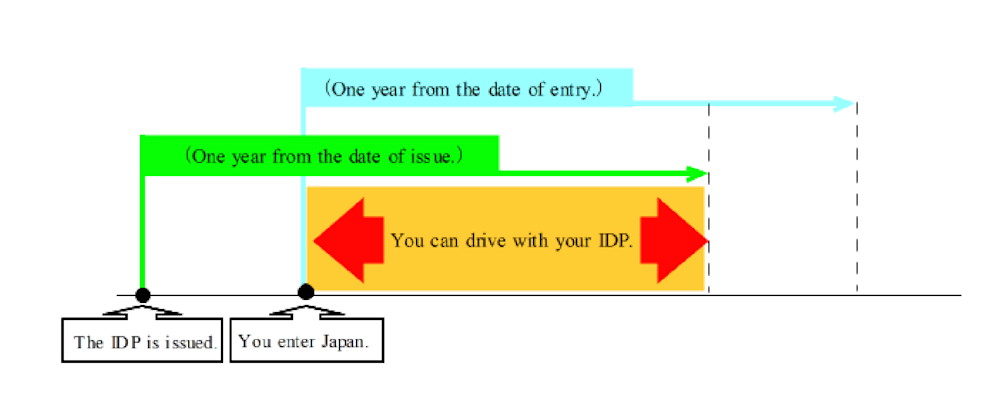
First diagram taken from Tokyo Metropolitan Police website.
More importantly, don’t forget to carry your passport and a valid driver’s license from your home country, in addition to the IDP. If you run into local authorities, you could be charged with driving without a license.
Otherwise, have fun exploring some of Japan’s most underrated and beautiful destinations.
And of course, if you’re coming from somewhere like America, don’t forget Japan drives on the other side of the road. It’s also probably in your best interest to read up on Japanese traffic rules before your trip.
Registered Residents

And this is exactly where IDP eligibility begins splitting into divergent branches.
There’s a lot of documentation out there in both English and Japanese.
Most aren't crystal clear, even with visuals and flow charts.
First off, what defines a "registered resident"?
This includes foreign residents, Japanese Nationals, and other resident subgroups living in Japan. With a particular emphasis on mid to long-term residencies.
But no matter what registered resident group you’re in, I’m just going to say this:
Don’t use the IDP.
If you want to drive, you should either convert or get a Japanese Driver’s License.
Period.
There is way too much grey area to uncover.
Combine it with an officer who doesn’t know the IDP, like mine. You’re kicking a hornet’s nest and putting fate in the hands of a messy, legal scavenger hunt.
And trust me, you don’t want to leave anything up to chance when it comes to which side of the law you’re on.
If, for whatever reason, you’re still planning to use an IDP, you at least need to understand the “Three Month Rule”.
It’s outlined in diagrams two and three of the Tokyo Metropolitan Police’s documentation.
The second diagram below shows when you can't use an IDP.
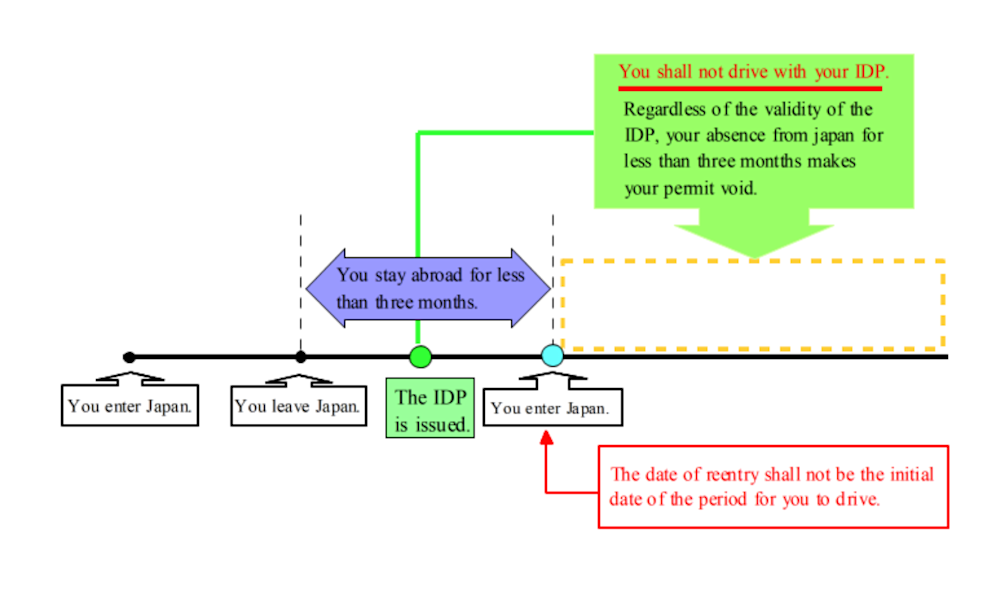
Second diagram taken from Tokyo Metropolitan Police website.
Essentially if you leave Japan for less than three months, get an IDP, then return to Japan, you cannot legally use the IDP.
The third diagram below shows when you can use an IDP.
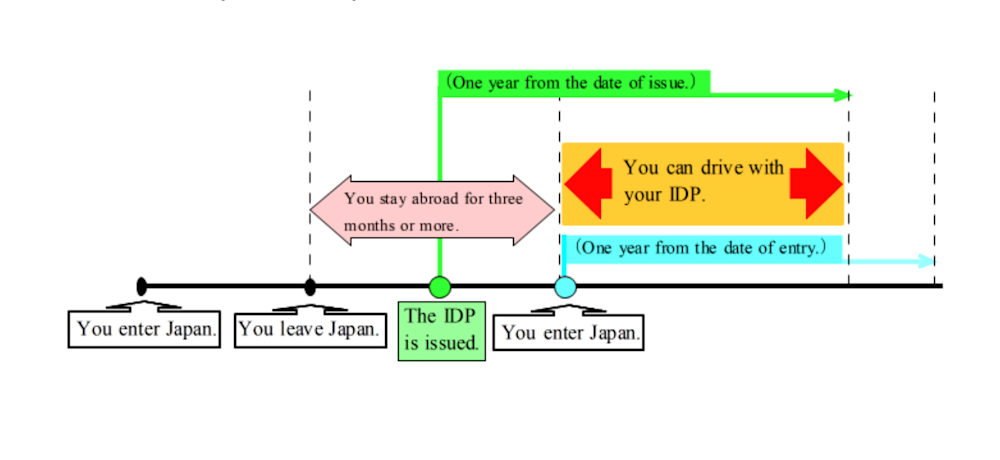
Third diagram taken from Tokyo Metropolitan Police website.
If you leave Japan for more than three months, get an IDP, and then return to Japan, you can use the IDP.
But what exactly changes in those three months that makes the IDP okay to use?
Although not explicitly stated, diagram one also pertains to registered residents, which we already talked about for short-term visitors.
Diagram one states that the IDP is eligible to use from either one year out from the date of entry, or by the IDP's expiration date.
And so, by definition of the “Three Month Rule”, after living three months abroad and receiving an IDP, the entry date gets reset. In particular, this is important if you’ve lived in Japan for over a year.
Because if you weren’t abroad for more than three months and received an IDP, your date of entry is still recorded as the first day you moved to Japan. Meaning, you violate the one-year rule from diagram one.
These conditions are formally outlined in the Japanese Road Traffic Act (Article 107-2).
Confusing? This is only the beginning.
Because now, I can hear a lot more questions.
Like, wait a minute. What happens if I get an IDP right before my first year moving to Japan? Couldn’t I use the IDP in my first year?
Well, that’s a great question.
According to Toyota’s Rent a Car flowchart, they’d say you could. And according to their chart, it almost looks like the “Three Month Rule” doesn’t apply in your first year of living in Japan.
And this gets backed up by the Tokyo Metropolitan Police on another part of their website in Japanese. There’s an additional diagram not included in their English documentation. It outlines a case where the initial year is an exception to the “Three Month Rule”.
But it gets puzzling, because if you look at another page on their website, they don’t include this clause. And in fact, it only focuses on whether you were abroad for three months as the basis.
See what I mean?
You're soon stuck in an infinite loop of open clauses, contradictory resources, and undefined specifics.
And that’s why I’m repeating, just don’t use the IDP.
It’s not intended for registered residents to use in general.
The U.S. Embassy of Japan also blatantly discourages its use for U.S. residents in Japan. They, too, urge you to convert or get a Japanese Driver’s License.
And had I known any of this, I would have never driven in Japan with an IDP. But I was genuinely ignorant and watched my case unravel in real time with my police officer.
Back to my case.
The police officer spent at least six additional hours figuring out what to do with me. And my ruined summer vacation plans were the least of my worries.
The police officer noted my two-year residency. And my IDP was acquired while abroad during a stay of less than three months.
At this point, I’m sure you can make some calculations based on the information above. It was clear: I was in direct violation of the “Three Month Rule”, meaning I was driving with an invalid IDP.
So what exactly happens in this case?
What is the penalty for driving with an invalid IDP in Japan?

So, if you’re caught with an invalid IDP, you can be charged with driving without a driver’s license. This means up to three years of jail, or a hefty fine of up to 500,000 yen.
Uh oh.
So what happened to me?
Does this story conclude as an episode of Locked Up Abroad?
Despite that information coming straight from the Chiba Police, I made it out okay.
No jail time, no penalty fees.
Ultimately, the buck was passed to the rental car agency for providing me a car with an invalid IDP.
And in the end, I was let off with a stern warning. I'd never drive in Japan again unless I got a Japanese driver's license. Also, my partner and I had to find our way back home without a car. Which, at this point, was the least of our concerns.
And after living in Japan for many more years, I’d hear similar stories.
Most mentioned they didn’t run into any trouble. Like me, they were oblivious but realized they weren’t supposed to be driving with an IDP.
Some said they found out when rental car companies knew about the IDP policies and denied them at the front gates.
But in one case, someone was deported from Japan and stripped of their residency.
Although I don't know if it was strictly because of the invalid IDP or anything more, it serves as a stark reminder. In some cases, ignorance of the law isn't a good enough excuse.
Because the last thing anyone wants is to risk deportation or getting arrested in Japan.
So what then if you are a resident? How can you drive safely in Japan?
Japan Driver’s License Conversion
And the best way to drive safely as a resident is to convert your driver's license if possible.
Conditions vary depending on your country (or State in my case) of origin.
If you're in the lucky group that doesn't have to take the written or driver's exam, even better. It's a much simpler process. Mainly, it's focused on compiling the proper documentation and passing a vision test.
As of 2025, these are the countries and US states that allow direct conversion:
-
Europe:
Austria, Belgium, Czech Republic, Denmark, Finland, France, Germany, Greece, Hungary, Iceland, Ireland, Italy, Luxembourg, Monaco, Norway, Poland, Portugal, Slovenia, Spain, Sweden, Switzerland, The Netherlands, The United Kingdom
-
Asia/Oceania:
Australia, New Zealand, Canada, Taiwan, South Korea
-
United States
Hawaii, Maryland, Virginia, Washington, Ohio, Oregon, Colorado, Indiana (Note: Indiana licenses will still take the written test but are exempt from the driving test).
Now what do you do if you’re like me and you’re not on that list of lucky countries and states, but you still have a valid driver’s license you’d like to convert?
Hate to break it to you, but you’re in the group that needs to pass both the written and driving tests in Japan first. In my case, California got snubbed from the list of eligible U.S. states.
Even more, the written test for license conversions was recently beefed up from ten questions to fifty. Before October 2025, you only needed to pass with a seven out of ten. Now, it's forty-five out of fifty.
And just around the corner is the infamous Japanese practical driving test. You’ll definitely want to familiarize yourself with it before signing up. And even more, it might be worth your time to sign up for driving school first.
Closing Remarks
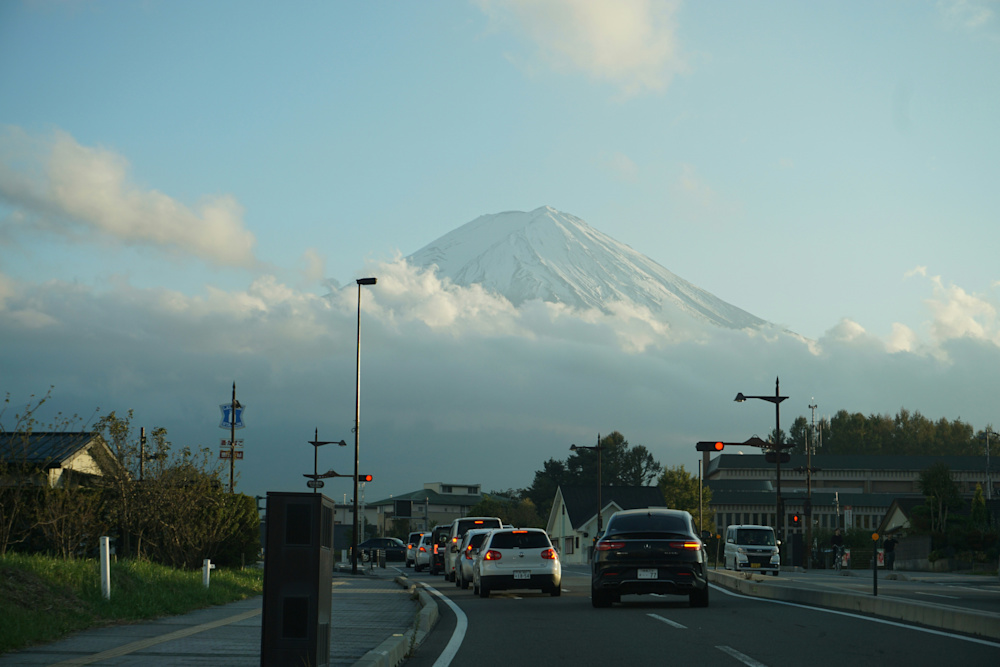
While the IDP is a wonderful and legitimate way to explore Japan for short-term visitors, if you live here, it’s best to think twice.
And as a resident, once you have your own official Japanese Driver’s License, you can even start thinking about buying your own car.
That said, driving in Japan, regardless, is an amazing way to amplify your experience of both living and visiting in Japan.
However, it’s best not to let that road guide you down a legal detour you never intended to drive.


Garrett Omi
Garrett is a yonsei (4th generation Japanese American) originally from the San Francisco Bay Area. Currently, he works as a software engineer and resides in Kamakura with his wife and son. Outside of coding and writing, you’ll most likely find him on the beach or at home roasting coffee.
- Full Stack Engineer, Tech Lead Track
- KATIX
- Tokyo
- ¥5M ~ ¥8M
- Engineering Team Lead, Management Track
- KATIX
- Tokyo
- ¥7M ~ ¥9M
- Senior Backend Engineer - Full Cycle Retail Robotics Engineering
- Telexistence
- Tokyo
- Reliability Engineer, Market Data
- Two Sigma
- Tokyo
- FullStack Engineer (Satellite Opearation Planning)
- Synspective
- Tokyo




Latest Tech Jobs 🇯🇵
Explore the top developer jobs in Japan for foreigners
- Full Stack Engineer, Tech Lead Track
- KATIX
- Tokyo
- ¥5M ~ ¥8M
- Engineering Team Lead, Management Track
- KATIX
- Tokyo
- ¥7M ~ ¥9M
- Senior Backend Engineer - Full Cycle Retail Robotics Engineering
- Telexistence
- Tokyo
- Reliability Engineer, Market Data
- Two Sigma
- Tokyo
- FullStack Engineer (Satellite Opearation Planning)
- Synspective
- Tokyo
- Senior Software Engineer - Engage Studio
- Treasure AI
- Tokyo
- Customer Reliability Engineer
- Treasure AI
- Tokyo
- VP of Robotics System Engineering, Humanoid Team
- Telexistence
- Tokyo
- Senior Backend Engineer, Automated Reasoning (Rust)
- Noeon Research
- Tokyo
- ¥14M ~ ¥17M
- Product Manager (BizStack Platform)
- MODE
- Tokyo
- ¥8M ~ ¥9M



Get Job Alerts
Sign up for our newsletter to get hand-picked tech jobs in Japan – straight to your inbox.

© 2026 Japan Dev. All rights reserved.
Proudly built in Tokyo.


Curated with 💙 in Tokyo by Eric Turner
All our data is gathered from publicly available sources or contributed by users