



Updated July 24, 2026
Japan's Specified Residence Card (Tokutei Zairyū Card): Is It Worth Getting?
Japan announced the change of the ID card system for foreign residents on June 14, 2026. A new Specified Residence Card, or the Tokutei Zairyū Card (特定在留カード), merges the standard Zairyū Card and My Number Card into one.
One card instead of two. Fewer office visits. Built-in health insurance.
Sounds simple. But the rollout has some complications, and people are rushing to switch before the system is ready for them. This guide covers everything you need to know. What the card is, what changed for everyone (including people who don't switch), who should consider switching now, and what our honest recommendation is.
What Is the Specified Residence Card (Tokutei Zairyū Card)?
To understand the new card, you first need to understand the two cards it replaces.
Most foreign residents in Japan carry two completely separate IDs, issued by two different government bodies:
A Zairyu Card (在留カード): your residence card, issued by the Immigration Services Agency. It shows your name, nationality, date of birth, residence address, visa status, and how long you're permitted to stay in Japan.
A My Number Card (マイナンバーカード): Japan's national identification card, issued by your local city or ward office. It displays your 12-digit My Number (similar to a Social Security Number in the US) and functions as a general-purpose ID for taxes, health insurance, government services, and sometimes banking.
The problem with the two-card system is that the two cards operate under different government systems. Any time your residence status changes, you have to update both cards at two different offices. Renew your visa? Visit Immigration. Then go to your ward office. Move to a new address? While the ward office handles the address update and notifies Immigration on your behalf, the separate My Number Card often requires additional manual steps or re-issuance at the ward office, creating unnecessary friction.
The Tokutei Zairyū Card merges both into one document, legally recognized as both a Zairyu Card and a My Number Card under Japanese law.
Getting one as of now is optional. You can keep your two separate cards as long as you want.
The new card is available to:
Mid-to-long-term residents.
Special Permanent Residents, who apply for a related version called the 特定特別永住者証明書 (Tokutei Tokubetsu Eijuusha Shoumeisho)
New arrivals at airports will still receive a standard Zairyu Card at the immigration counter. The Tokutei Card cannot be issued at the airport.
The 2026 Zairyu Card Redesign: What Changed for Everyone
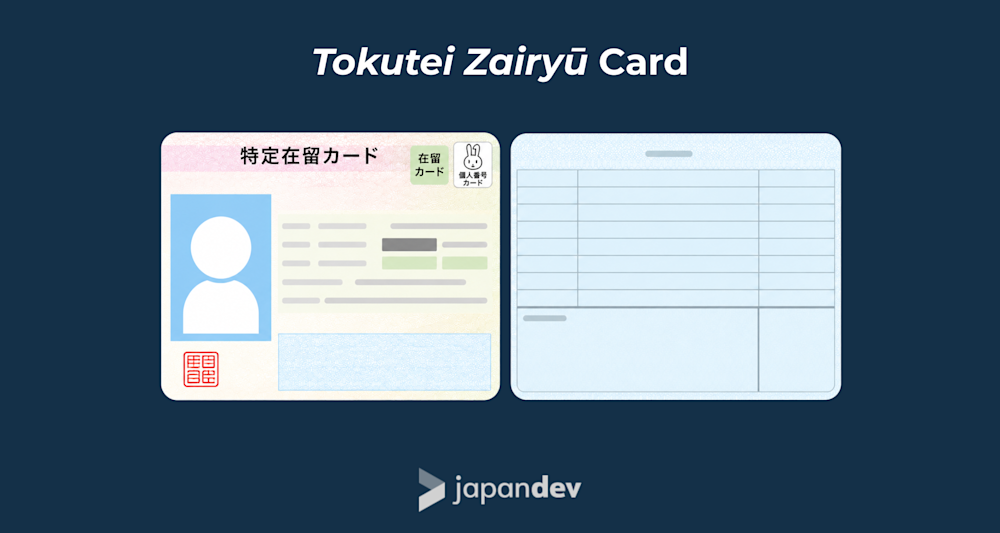
These new changes apply to your card whether you switch to the Tokutei version or not.
Starting June 14, 2026, all newly issued “Zairyu Card” use a redesigned format. That includes standard cards from regular visa renewals. If your card comes up for renewal anytime from mid-June 2026 onward, the card you receive will look different from the one you have now.
The biggest change: several details that used to be printed on the front face of the card have moved to the card's IC chip. You can no longer read these details by looking at the card:
Period or length of stay
Type of permission (e.g., "Engineer/Specialist in Humanities/International Services")
Date of permission
Date of issuance
To read this information, the cardholder or a third party uses an official government smartphone app that scans the chip. However, the expiry date is still visible on the card face.
More changes to the standard new-format card:
Children aged 1 to 15 must now have a photo on their card, bringing it in line with My Number Card rules
For Permanent Residents, card validity extends from 7 years to until the holder's 10th birthday after issuance (5th birthday for those under 18)
The current card remains valid until the expiry date printed on it. No need to rush to update it.
Here's a quick overview of how the new card format compares to the old one:
Detail |
Old Zairyu Card |
New-Format Zairyu Card (from June 14, 2026) |
Period/length of stay |
Printed on front |
Stored in IC chip only |
Visa type/permission date |
Printed on front |
Stored in IC chip only |
Card expiry date |
Printed on front |
Still printed on front |
Permanent Resident validity |
7 years |
Until 10th birthday after issue |
Photo for children 1-15 |
Not required |
Required |
Why does this matter in practice? Well, banks, landlords, and employers who verify your visa status by looking at the face of your card can no longer do it that way. They need to scan the chip with the official app.
BUT most of them don't know this yet. So if your card comes up for renewal and you work with a company or landlord who checks your visa status, flag this change before your new card arrives.
A Closer Look at the Benefits of the Tokutei Zairyū Card
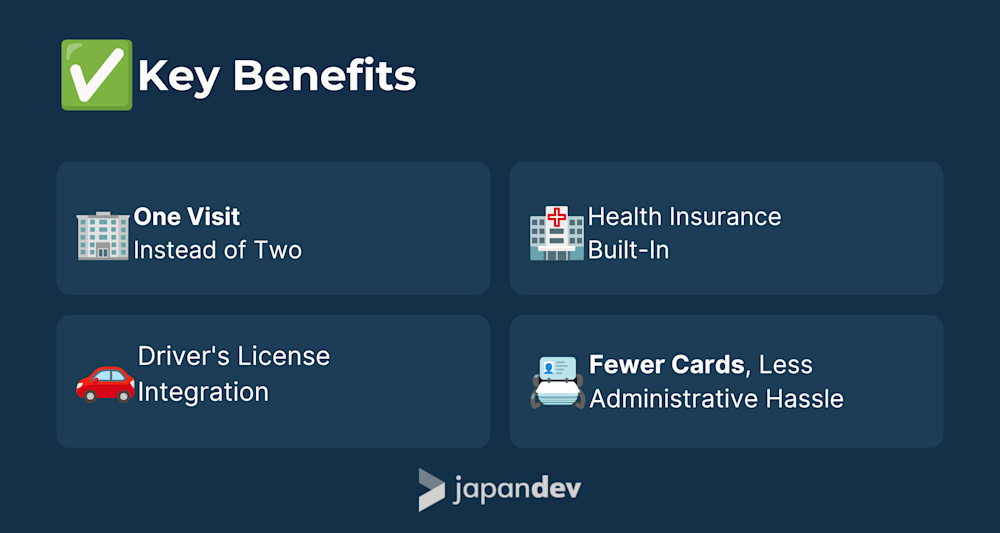
Now let’s talk more in-depth about the optional Tokutei Card. A one-stop procedure is the most valuable thing the Tokutei Card offers, and it's an improvement for anyone who has dealt with the two-office dance.
One Visit Instead of Two
Currently, updating your address requires two separate trips:
Update your address at your ward office.
Update or reissue your separate My Number Card (sometimes requiring extra paperwork during that same visit, or even a separate trip depending on your municipality)
Miss either one and you could face complications down the line with banking, taxes, or residence notifications.
With the Tokutei Card, both systems update at the same time. You notify your new ward office of your address change, and the My Number side updates automatically. No second trip.
The same logic applies to visa renewals and status changes. Right now, after Immigration approves your renewal and issues a new Zairyu Card, you still need to visit the ward office to update your My Number Card. That second visit goes away.
Health Insurance Built-In
The Tokutei Card functions as a Myna Health Insurance card (マイナ保険証). You can show it at hospitals and clinics instead of carrying a separate insurance card.
Japan has been pushing the My Number Card as a health insurance replacement for a few years now. The Tokutei Card makes this automatic for foreign residents who switch, with no extra enrollment steps required.
Driver's License Integration
If you hold a Japanese driver's license, you can also link it to the Tokutei Card after receiving it. This requires a separate visit to your local police station to re-register your license information.
Once linked, the card works as a digital driver's license (マイナ運転免許証), so you can carry one card for identity verification, residence status, health insurance, and driving.
Fewer Cards, Less Administrative Hassle
The day-to-day benefit is simple. One card to carry, one card to renew, one card to keep track of. Over a multi-year period of living in Japan, fewer procedures add up to real time saved.
The card also prints your registered nickname (通称名) if one is on file for you in your residential records.
What They Don't Tell You:
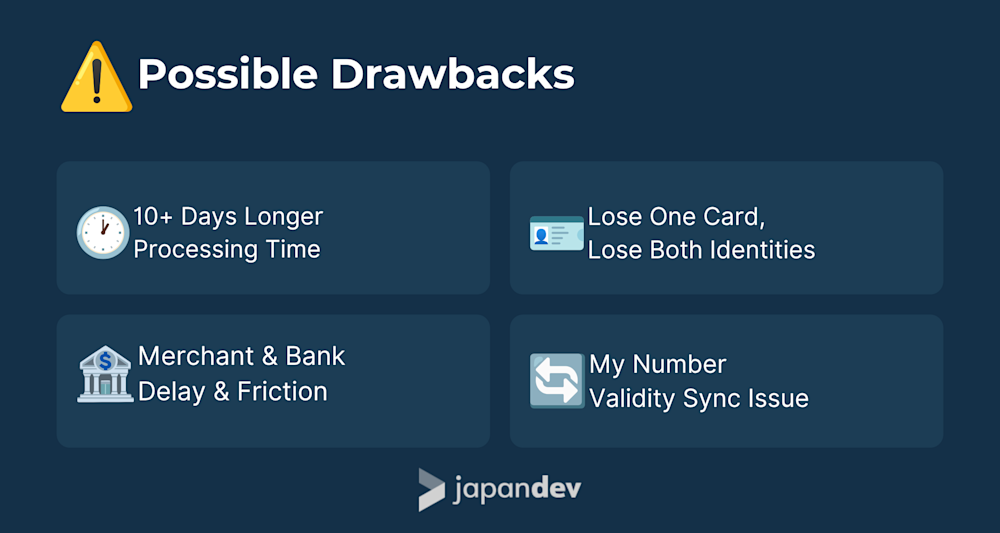
Everyone covers the pros. The cons take more digging to find, and they matter a lot for residents thinking about switching right now.
Processing Takes About 10 Days Longer
The Tokutei Card takes around 10 days longer to issue than a standard Zairyu Card. Immigration needs to coordinate with the My Number system behind the scenes before printing the card.
If your visa renewal has a tight timeline, or if you need your new card for banking or housing before a deadline, that extra wait adds pressure. Think about this before committing.
Losing One Card Means Losing Both Identities
Right now, if you lose your Zairyu Card, you deal with Immigration. If you lose your My Number Card, you deal with your ward office. Two separate inconveniences, each on its own.
Lose your Tokutei Card, and both identities are gone at the same time. The recovery process involves multiple agencies and multiple steps. It's not catastrophic, but it's more work than losing either card on their own.
There's also a security point worth taking into consideration. A single card that holds your residence status, national identification number, health insurance, and potentially your driver's license is a larger target.
Card skimmers, fraudulent readers, and physical theft all become higher-stakes events when everything is on one card.
Merchant and Bank Friction
Japan's private sector lags behind government systems on digital changes. Many banks, telecoms, and service providers check your visa status by looking at the details printed on your Zairyu Card. With status and period of stay now stored in a chip, they can't verify the information visually.
This affects everyone with a new-format card, not just Tokutei Card holders. But showing up with a brand-new, unfamiliar integrated card at a bank or when signing a lease creates more friction, especially in the early months of the rollout.
Some banks may ask for your juminhyo (住民票) with residence status printed on it instead, since that remains a straightforward paper document they understand.
The My Number Validity Sync Problem
This is a technical issue that not many people notice.
The My Number Card function on the Tokutei Card is tied to the validity of your residence status. When you apply for the Tokutei Card, the My Number function gets matched with your visa's expiry date.
The problem is that Immigration processing can take weeks. So, if your original card's expiry date passes before Immigration finishes your renewal, you may enter the standard two-month lawful stay period. During that window, the Tokutei Card is not valid as a My Number Card, because the underlying status it references has technically expired.
Ironically, you would need to visit your ward office to extend the My Number Card function manually before that grace period kicks in. That's an extra trip, one that kind of undoes the one-stop benefit of the Tokutei Card to begin with.
Who Should Actually Consider Switching Now?
Not everyone is in the same situation. So it varies by circumstance.
Your Visa Renewal Is Still 2+ Years Away
Don't switch. There's no qualifying procedure coming up that would let you apply, and the system needs time to stabilize. Revisit this when your renewal window opens.
Your Renewal Is Coming Up in the Next Few Months
Consider your priorities before deciding. If you want the integrated card, factor in the wait time, check that no deadlines (like a lease signing or bank account opening) conflict with that wait.
If nothing is time-sensitive, it may be worth trying. But if you're in any doubt, request the standard new-format card and avoid the extra complexity.
You're Moving to a New Address
Moving triggers an address registration at your new ward office, which is a qualifying event for the Tokutei Card. If your visa still has years left on it, this is technically one of the few opportunities to get the integrated card outside of a renewal.
That said, ward offices may be unfamiliar with the process this early in the rollout. So don't be surprised if staff need to look up the procedure.
Check out the Japan Dev guide on moving in Japan for what to expect during the address transfer process.
You're a Permanent Resident
PR holders don't renew their status, but they do renew the physical card itself. The Tokutei Card's biggest draw (one-stop visa renewals) matters less for PR holders. Since the only qualifying event is an address change or a card reissuance.
The benefit for PR holders comes down to health insurance integration and the driver's license link. If those features are worth it to you, the next address change or card renewal is your opportunity.
You're a New Arrival
You'll receive a standard Zairyu Card at the airport. The Tokutei Card can't be issued at the arrival counter. The first opportunity to switch comes when you register your address at your ward office after arriving.
At this point, the system is new and unfamiliar. Unless you have a specific reason to want the integrated card from day one, getting set up on the standard cards first is easier.
You Travel Frequently or Plan to Leave Japan Temporarily
Be aware that leaving Japan with a re-entry permit can complicate My Number Card status. Under current rules, moving out of Japan requires notifying your ward office, which can affect My Number Card activation. The Tokutei Card links these systems more tightly, which could create complications if you relocate temporarily. The rules around this are still being worked out.
Our Take: Wait and Watch
Look at reports from the early days of the rollout, and compare notes with people already trying the system. Our general recommendation is to hold off on switching for at least 12 months.
Here's the reason. Japan has a history of launching digital reforms at the policy level before the implementation layer is ready.
The My Number system itself took years to become functional and accepted across institutions.
The Tokutei Card is no different. At the local ward office in the weeks before the Tokutei launch, the staff had no knowledge of the new combined card whatsoever. The ward office is the exact institution responsible for the My Number function of the Tokutei Card. If those staff members don't know the system exists, the integration isn't ready for smooth adoption.
This isn't a criticism of the concept. The integration makes sense in the long term. But being an early adopter means dealing with:
Staff at Immigration and ward offices who are still learning the process
Banks and landlords who don't understand the new card format
The risk that small technical issues (like the My Number validity sync problem) catch you at an inconvenient time
No good way to undo the switch if problems arise, since you can't get your two separate cards back directly
Our advice in plain terms:
If your card has 2 or more years left, don't switch yet.
If your renewal is coming up, request the standard new-format card and skip the Tokutei option for now.
In 12 to 18 months, the system will be more stable, staff will be trained, and switching will be far less risky.
At some point this integration will likely become mandatory. But "voluntary for now" is a signal that the system still needs time to mature. Let other people work through the early friction first.
How to Apply: A Step-by-Step Guide
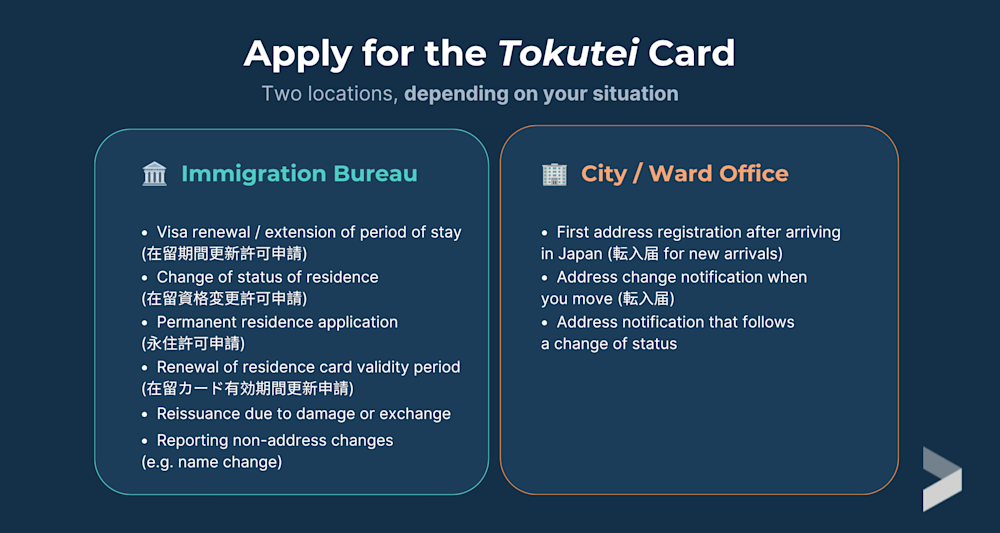
If you've decided to go ahead, here's exactly how the process works.
You cannot apply for the Tokutei Card online at this stage. The online immigration application system doesn't support it yet. You must appear in person.
Applications opened on June 15, 2026, the first business day after the card system launched. There's no standalone application. You apply for the Tokutei Card at the same time as another qualifying immigration or administrative procedure.
If you're planning a visa renewal alongside this, our guide on getting a visa as an engineer in Japan covers the full renewal process in detail.
Applying at an Immigration Bureau
You can apply at an Immigration Bureau during any of the following procedures:
Visa renewal / extension of period of stay (在留期間更新許可申請)
Change of status of residence (在留資格変更許可申請)
Permanent residence application (永住許可申請)
Renewal of residence card validity period (在留カード有効期間更新申請)
Reissuance of residence card due to damage or exchange
Reporting non-address changes to card information (like a name change)
Applying at Your City/Ward Office
You can apply at your local city or ward office during:
First address registration after arriving in Japan (転入届 for new arrivals)
Address change notification when you move (転入届)
Address notification that follows a change of status
Special Permanent Residents can apply at the City/Ward Office only, for address changes, reissuances, and validity renewals.
Documents You Need
Tokutei Zairyū Card application form (特定在留カード等交付申請書)
PIN setup form for My Number functions (暗証番号等設定依頼書)
One passport-style photo (4cm x 3cm, taken within the past 3 months, plain background)
Your current Zairyu Card
Your passport
Any documents required for the specific immigration procedure (for example, visa renewal paperwork, employment certificates, etc.)
Of course, exact requirements may vary by office, so call ahead or check the Immigration Services Agency website before your visit.
What Happens After You Apply
You leave the office and wait. The Immigration Bureau processes the combined card, which takes roughly 10 days longer than a standard card due to the My Number integration step. You'll receive a notice when the card is ready to pick up.
During the wait, your existing card stays valid until you receive your new one.
Is the First Switch Free?
Yes, switching from a Zairyu Card issued before June 13, 2026 to the Tokutei Card is free of charge for the first time. Future applications (like a full reissuance after loss) may carry standard fees, so confirm costs when you apply.
What to Do If You Lose Your Tokutei Specified Residence Card?
Losing your Tokutei Card is more serious than losing either card individually, because both your residence identity and your My Number identity disappear at the same time.
Call 0120-95-0178 (the My Number Hotline) to freeze the card's electronic functions. This line operates 24 hours a day, 7 days a week. They will suspend the card electronically. Preventing anyone from using it for digital identity verification while you sort out the reissuance.
File a loss report at your nearest police box (koban) or police station.
Visit your local Immigration Bureau to apply for a reissuance. The replacement card they issue will be a standard Zairyu Card, not a Tokutei Card. You go back to carrying two separate cards.
Apply for the Tokutei Card again during a future qualifying procedure if you want to return to the integrated system.
One thing to be clear about, the recovery process after losing a Tokutei Card involves at least two government agencies (the My Number hotline, then Immigration). By comparison, losing a standard Zairyu Card only involves Immigration. Losing your My Number Card only involves your ward office. This is also worth thinking about before you switch.
Frequently Asked Questions
Here are the most common questions about the new card system.
Is getting the Tokutei Zairyū Card mandatory? No. It's 100% optional. You can keep your separate Zairyu Card and My Number Card for as long as you like. The option to switch exists, but nothing forces you to take it.
Does the Tokutei Card work as a health insurance card? Yes. It functions as a Myna Health Insurance card (マイナ保険証). You can show it at hospitals and clinics in place of a separate insurance card, the same as a regular My Number Card with Myna health insurance enrolled.
Can I use the Tokutei Card during the two-month renewal grace period if Immigration hasn't finished processing my renewal by the time my visa expires? Yes. During the two-month lawful stay period, you are permitted to remain in Japan and continue working because your underlying visa status is legally extended. The Tokutei Card (and standard Zairyu Card) remains valid as proof of your legal status during this time, provided the back of the card stamped by Immigration to show a renewal application is pending. But because the expiration date on the front of the card has passed, some third-party institutions like banks or mobile carriers might still restrict your services until the new card is issued.
Will my current card become invalid on June 14, 2026? No. Your existing Zairyu Card and My Number Card remain valid until their respective printed expiry dates. You don't need to do anything.
Can I apply for the Tokutei Card without any other procedure coming up? No. The Tokutei Card can only be issued at the same time as a qualifying immigration or administrative procedure. You can't visit Immigration or your ward office and request the card alone.
What's the difference between the Tokutei Zairyū Card and the new-format standard Zairyu Card? Both use the redesigned card format from June 14, 2026 (with status details in the IC chip). The key difference is that the Tokutei Card merges My Number functions into the card. The standard new-format Zairyu Card does not include My Number functions and doesn't print your My Number on the card.
Can I get the Tokutei Card when I first arrive in Japan? No. New arrivals receive a standard Zairyu Card at the airport. The Tokutei Card cannot be issued at arrival. Your first opportunity to switch comes when you register your address at your new ward office.
How long does the Tokutei Card take to arrive? Approximately 10 days longer than a standard Zairyu Card, due to the My Number integration process. Plan for this if you need your new card by a specific date.
Does it work as a driver's license right away? Not immediately. To use the Tokutei Card as a digital driver's license, you need to visit your local police station after receiving the card to re-register your license information. Once that's done, the card functions as a マイナ運転免許証 (Myna driver's license).
What if a landlord or bank says they can't accept my new card? This is an early-rollout friction problem. The IC chip verification app is the official way to confirm visa status on new-format cards. If a third party insists on seeing printed details that no longer exist on the card surface, one option is to provide a certified copy of your juminhyo (住民票) with residence status listed. That's a familiar document that most institutions understand.
For a detailed look at how the current Zairyu Card system works and what information it holds, the Japan Dev Zairyu Card guide is a helpful starting point.
Tokutei Card vs. Keeping Two Separate Cards
Use this table to make the decision for your own situation:
Factor |
Tokutei Zairyū Card |
Two Separate Cards |
Number of physical cards |
1 |
2 |
Visa renewal procedure |
Immigration only |
Immigration + ward office |
Address change procedure |
One office (automatic My Number sync) |
One office (manual My Number sync/re-issuance required) |
Processing time |
~10 days longer |
Standard timing |
Health insurance function |
Built in |
Separate enrollment |
Driver's license function |
After police station re-registration |
Not available |
Lost card recovery |
Multi-agency, more complex |
Separate simpler processes |
bank/landlord acceptance |
Might face friction in 2026 |
Familiar to most of them |
Risk if card is lost |
Both identities at once |
One ID at a time |
Cost to switch initially |
Free (from pre-June 13, 2026 card) |
No switch needed |
Final Thoughts
The Specified Residence Card (Tokutei Zairyū Card) is a long-term improvement to how Japan handles foreign resident ID. One card, fewer office visits, and integrated health insurance functions are all valuable things.
But the system launched just weeks ago. Ward office staff are still being trained. Banks and landlords haven't adjusted to the new card format. The recovery process for a lost card is more complex than before.
For most foreign residents in Japan right now, the right call might be to wait. Let the system stabilize over the next year or so. By the time your next renewal comes around, the process hopefully will be smoother, institutions will be more familiar with the new format, and the risks of switching will be much lower.
When you're ready to take the next step in building your life in Japan, browse the Japan Dev list of curated tech companies hiring foreign developers.


Hasan Ali
Born and raised in Libya, Hasan spent the last 6 years exploring Japanese culture while living in Nagano and Aichi. His journey began at a high school in the town of Karuizawa, followed by a Bachelor of Business in Nagoya. Professionally, He is an SEO and content specialist with over 3 years of experience crafting digital strategies. When not working, He is trying to catch up on his goal of visiting every single prefecture in Japan.
- Senior Backend Engineer (Go), Communication Platform Department, ...
- Money Forward
- Tokyo
- ¥7M ~ ¥11M
- Software Engineer
- Infostellar
- Tokyo
- Operations Engineer
- Infostellar
- Tokyo
- Machine Learning Engineer
- VISASQ
- Tokyo
- ¥7M ~ ¥15M
- Staff AI Engineer (AI Agents Development), CDAO Office, Tokyo
- Money Forward
- Tokyo
- ¥11M ~ ¥20M



Latest Tech Jobs 🇯🇵
Explore the top developer jobs in Japan for foreigners
- Senior Backend Engineer (Go), Communication Platform Department, ...
- Money Forward
- Tokyo
- ¥7M ~ ¥11M
- Software Engineer
- Infostellar
- Tokyo
- Operations Engineer
- Infostellar
- Tokyo
- Machine Learning Engineer
- VISASQ
- Tokyo
- ¥7M ~ ¥15M
- Staff AI Engineer (AI Agents Development), CDAO Office, Tokyo
- Money Forward
- Tokyo
- ¥11M ~ ¥20M
- AI Engineer (AI Agent Platform Development), ERP
- Money Forward
- Tokyo
- ¥7M ~ ¥11M
- Lead Cloud Engineer
- Mico
- Tokyo
- ¥7M ~ ¥11M
- Department Manager, PRE Division, Platform Department, Tokyo
- Money Forward
- Tokyo
- ¥7.9M ~ ¥15M
- Computer Vision Engineer (Object Detection & 3D Pose Estimation)
- Mujin
- Tokyo
- ¥8M ~ ¥13M
- Robotics Algorithm Engineer (Control & Motion Planning)
- Mujin
- Tokyo
- ¥8M ~ ¥13M


Get Job Alerts
Sign up for our newsletter to get hand-picked tech jobs in Japan – straight to your inbox.

© 2026 Japan Dev. All rights reserved.
Proudly built in Tokyo.


Curated with 💙 in Tokyo by Eric Turner
All our data is gathered from publicly available sources or contributed by users