



Updated April 21, 2025
Japan's NHK Fee for Foreigners: Do You Have to Pay?
Moving to Japan comes with a fair share of new experiences and responsibilities, including the often-confusing NHK receiving fee.
If you’ve ever had someone unexpectedly ring your doorbell asking about your TV, you’ve likely encountered an NHK fee collector. This mandatory payment puzzles foreign residents, sparking debates about whether it’s necessary or even enforceable.
In this article, we’ll demystify this concept by breaking down the NHK fee, who has to pay it, how much it costs, and what happens if you choose not to pay.
First, let’s start by explaining the NHK fee for foreigners.
What is the NHK Subscription Fee?
NHK, short for Nippon Hōsō Kyōkai, is Japan’s Public broadcaster, offering a range of television and radio services. Established under Broadcast Law, NHK operates independently from commercial advertising, relying primarily on receiving fees paid by viewers.
This funding model ensures that NHK can deliver impartial and high-quality content to the public.
According to Article 64 of the Broadcast Law, if you have a device that’s capable of receiving an NHK broadcast, such as a TV, smartphone, or computer, you are required to enter into a receiving contract with NHK and pay the associated fee.
This obligation applies to all residents of Japan, regardless of nationality. The rationale is to maintain a fair system where everyone benefiting from NHK services contributes equally to its operation.
It’s worth noting that the receiving fee isn’t a subscription in the traditional sense. Even if you don’t actively watch NHK programs, owning a compatible device necessitates the payment.
While some may find this approach disappointing, it supports NHK’s mission to provide universal access to information and cultural programming across Japan.
NHK Fee Cost: How Much Are NHK Fees?
If you own a device that can receive an HK broadcast, whether it’s a television, smartphone, or even a computer, you’re required to pay the receiving fee. NHK categorizes its contracts into two types:
Satellite contract: This covers both terrestrial and satellite broadcasts, giving you access to a wider range of channels.
Terrestrial contract: This covers terrestrial broadcasts, which include NHK standard programming but excludes satellite-only channels.
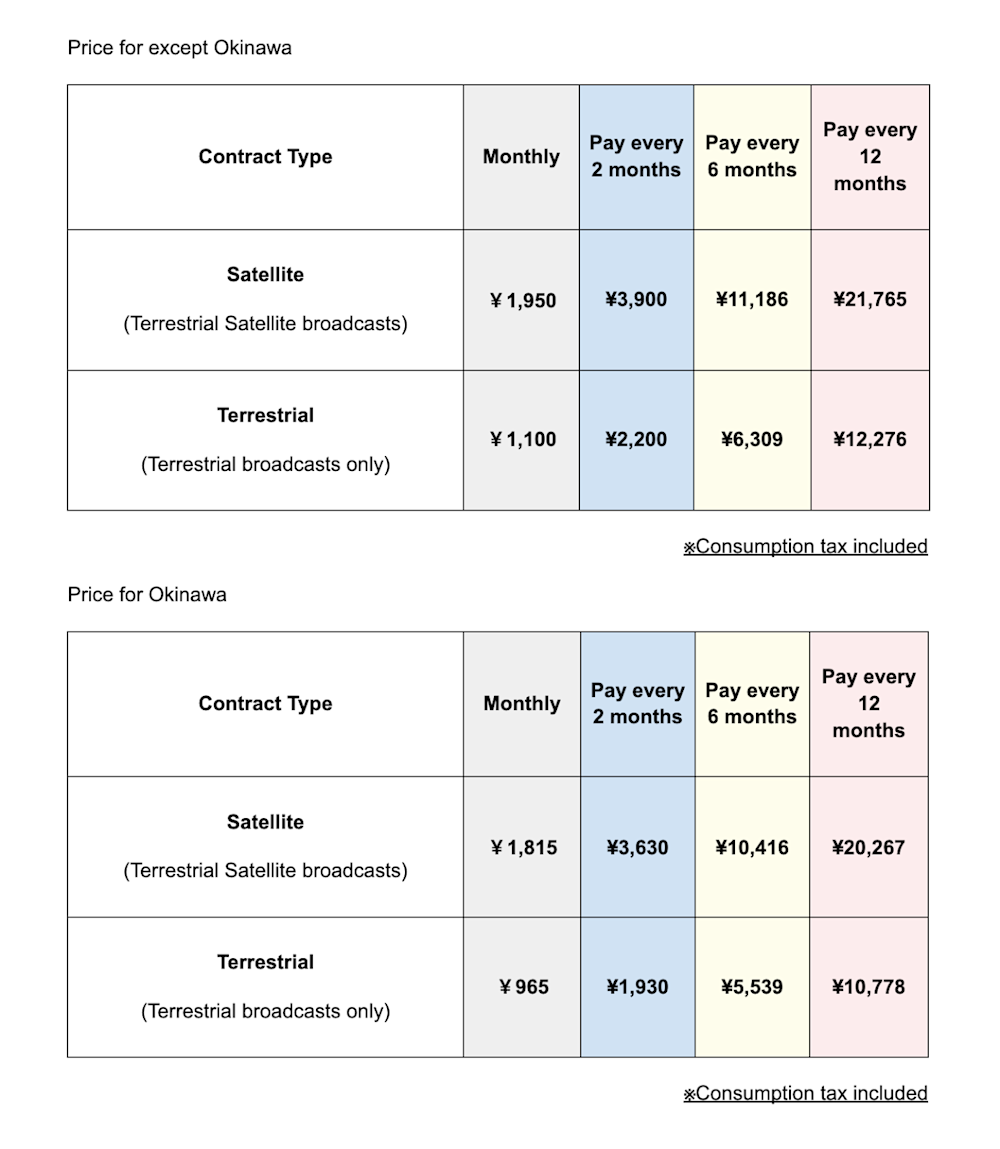
Here are the prices for NHK fees, both for satellite and terrestrial contracts. Keep in mind that the fees for Okinawa and the rest of Japan differ, as shown in the tables below:
When Are NHK Fees Collected?

NHK fees follow a structured collection schedule, typically due every two months.
However, for those who prefer fewer transactions, NHK provides an option to pay in advance for six months or a full year, which also comes with a small discount. While the savings aren’t massive, it's a helpful way to avoid dealing with frequent invoices.
If you're wondering about collection methods, NHK offers several payment methods. You can set up an automated credit card or bank transfer payment, which ensures you don't forget a due date.
If you prefer manual payments, NHK also sends invoices you can pay at banks, Post Offices, or even convenience stores (read more about the Japanese konbini culture). The convenience store option is particularly useful for those without a Japanese bank account or credit card.
For the most up-to-date pricing and payment options, check out the official NHK website.
Is It Mandatory to Pay NHK?
Yes, paying the NHK fee is legally mandatory for anyone with equipment capable of receiving NHK broadcasts.
This means that if you own a device capable of receiving NHK broadcasts, you are legally required to pay, regardless of how often you watch NHK programming.
That being said, there are exceptions to this rule, and some individuals may qualify for an exemption.
Who Qualifies for an Exemption from the NHK Monthly Fee?
NHK does provide exemptions in certain cases, which can significantly reduce or even eliminate the required fees. These exemptions fall into two categories:
Full exemption:
Households receiving public assistance
Individuals with severe disabilities who are exempt from municipal inhabitant tax
Residents of social welfare facilities
Disaster victims who have lost their homes due to a natural disaster
Students living away from their families and without financial support
Partial exemption:
Households where the main provider has a visual, hearing, or severe physical disability
Households experiencing financial hardship but not classified under the full exemption
It’s important to note that exemptions are not automatically granted—you must apply through NHK to be considered. Applications typically require documentation proving your eligibility, such as disability certificates, proof of public assistance, or tax-exemption documentation.
If you think you might qualify based on the criteria above, it’s best to check the latest eligibility requirements and application process on the NHK exemption list (Japanese link).
So, Do You Really Have To Pay The NHK Annual Fee?
Technically, if you have a device capable of receiving NHK broadcasts, you're legally required to pay. However, in practice, many residents, both Japanese and foreign, either refuse to pay or find ways to avoid it.
Many people argue that since an NHK is not a subscription service but a mandated payment, it feels unfair, especially if they never watch NHK content.
So, What Do Japanese People Do?
While some Japanese households dutifully pay their NHK fees, many others either ignore the bills or actively avoid NHK fee collectors.
It's a well-known fact that NHK struggles to collect payments, and while they do attempt to enforce the law, its success is somewhat limited.
After all, nearly every person in Japan is required to pay it, but not paying it is so common that there just isn’t enough workforce to pursue every single household. Though making a contract with NHK is mandatory, some avoid paying by never signing a contract, despite potential financial consequences later.
Others partially play by the rules but prepare to argue their case when collectors appear at their door.
Dealing With The NHK Man: NHK Fee Collectors
NHK employs fee collectors who visit households to secure payments. These collectors typically visit between 11 AM and 9 PM, sometimes showing up multiple times a week.
If you don't want to pay, the easiest way to avoid getting into a discussion is simply not opening the door. Collectors, known colloquially as the “NHK Men,” are persistent, but they cannot legally force their way into your home or make you sign a contract on the spot.
Some residents choose to tell collectors that they don’t own a television or any NHK-compatible devices. Others say they don’t understand Japanese and refuse to engage in conversation.
While these tactics might work, it's important to be aware that NHK has increased enforcement efforts, and legal consequences for nonpayment have become stricter in recent years.
If you want to stay on the safe side and avoid potential fines, paying the NHK fee is the best course of action. However, if you don't have a TV and never watch NHK, you'll find that most people in Japan simply choose not to answer the door when the NHK man comes knocking.
Penalties for Non-Payment of The NHK Fee Japan
While we have mentioned that not paying the NHK fee is something many people do, this doesn't mean that there are no repercussions.
In April 2023, amendments to the Broadcast Law introduced even stricter penalties for non-compliance, making it harder to dodge NHK fees without potential repercussions.
So, what happens if you don't pay?
For one, if you fail to establish a contract and pay your NHK fees on time, you could face financial penalties. Here's what you need to know:
Failure to establish a contract: If you don't sign up for an NHK contract by the last day of the second month following the month of installation, you may be required to pay the overdue fees along with an additional charge equal to twice the amount owed.
Fraudulent evasion: Attempting to mislead NHK, such as providing false information to avoid payment, can result in a penalty of up to double the unpaid fees.
So, Will NHK Take Legal Action for The NHK Fee Cost?
While NHK does have the authority to take legal action against non-payers, lawsuits are relatively rare and usually target high-profile cases where large sums are owed.
That being said, NHK has been stepping up its enforcement efforts in recent years, making it risky to ignore payment demands.
Here’s how the NHK usually goes about dealing with those who avoid NHK fee collection:
Repeated notices: If you don't pay, expect to receive repeated notices and letters from NHK.
Strong-worded warnings: If you continue to refuse to pay, you can expect increasingly strong-worded letters warning you of the repercussions.
Frequent house visits: Continued refusal to pay can also result in more visits from the NHK man, which increase in frequency the longer you ignore the notices.
As we mentioned, NHK collectors cannot force you to pay on the spot, nor can they enter your home without permission. However, ignoring them indefinitely can certainly result in increased pressure, additional fees, or, in rare cases, legal consequences.
Conclusion on The NHK Fees Japan

Understanding and navigating the NHK receiving fee is a part of residing in Japan. While the law requires payment from those with the necessary equipment, it’s good to be informed of the regulations, exemptions, and potential penalties to make informed decisions.
For more insights about living in Japan as a foreigner, check out our Handy Items to Carry in Your Bag as a Business Person in Japan and The Zairyu Card: How to Navigate Japan's Residency System articles.


Japan Dev Editorial Team
Guides and articles about tech and life in Japan from our Japan-based editorial team. Articles are researched from Japanese government sources and our standards are overseen by Manami Turner, Co-founder of Japan Dev.
- Senior Backend Engineer
- Tokenz
- Tokyo
- Senior Accounting Engineer / 財務データ基盤エンジニア
- KOMODO
- Tokyo
- Tech Lead Engineer (Voice/Speech)
- Geniee
- Tokyo
- ¥7M ~ ¥16M
- Data Engineer (AI Platform/Data Infrastructure)
- PubteX
- Tokyo
- ¥7M ~ ¥12M
- Computer Vision Engineer (Object Detection & 3D Pose Estimation)
- Mujin
- Tokyo
- ¥8M ~ ¥13M





Latest Tech Jobs 🇯🇵
Explore the top developer jobs in Japan for foreigners
- Senior Backend Engineer
- Tokenz
- Tokyo
- Senior Accounting Engineer / 財務データ基盤エンジニア
- KOMODO
- Tokyo
- Tech Lead Engineer (Voice/Speech)
- Geniee
- Tokyo
- ¥7M ~ ¥16M
- Data Engineer (AI Platform/Data Infrastructure)
- PubteX
- Tokyo
- ¥7M ~ ¥12M
- Computer Vision Engineer (Object Detection & 3D Pose Estimation)
- Mujin
- Tokyo
- ¥8M ~ ¥13M
- Robotics Algorithm Engineer (Control & Motion Planning)
- Mujin
- Tokyo
- ¥8M ~ ¥13M
- Enterprise Architect, ERP Cross-Functional Engineering Department...
- Money Forward
- Tokyo
- ¥13M ~ ¥18M
- Robotics Software Engineer, Motion Planning - Logistics Division
- Telexistence
- Tokyo
- SRE - DataOps/MLOps
- Autify
- Tokyo
- ¥8.5M ~ ¥10M




Get Job Alerts
Sign up for our newsletter to get hand-picked tech jobs in Japan – straight to your inbox.

© 2026 Japan Dev. All rights reserved.
Proudly built in Tokyo.


Curated with 💙 in Tokyo
All our data is gathered from publicly available sources or contributed by users