



Updated October 18, 2026
How to Write Job Descriptions That Attract Global Engineers in Japan
※ 本記事の日本語版はこちら
In this article: 📝
- Why Your Global Engineer Job Postings Underperform: The Japan Market Challenge
- 3 Key Points: Writing Job Posts for Global Engineers
- Keep the tone friendly
- Understand the role before you write about it
- Write in English
- Why You're Not Getting Applications: Ambiguity Is Costing You
- Job Descriptions: Essential Elements & Our Recommended Order
- About the Role
- Responsibilities: Key Points for Attracting More Applicants
- Other Details: Ensure Transparency and Clarity
- Additional Tips For Increasing Application Rates: Using Job Descriptions and Company Profiles Effectively
- Job Post vs. Company Profile
- Additional Information to Include in Job Descriptions
- What to Include in the Company Profile
- Common Mistakes
- FAQ
- What Makes a Job Post Attract More Applicants?
- What Do Engineers Look for in a Job Post?
- Japan Dev Job Posting Templates
- Summary: Final Checklist
Why Your Global Engineer Job Postings Underperform: The Japan Market Challenge
"The salary is competitive. The tech and product is interesting. But we're not getting many applicants."
This is one of the most common things we hear from HR teams trying to hire international engineers in Japan. As of November 2025, Japan's engineer job-to-applicant ratio is roughly 4:1. This means that more than four companies are competing for every single engineer.
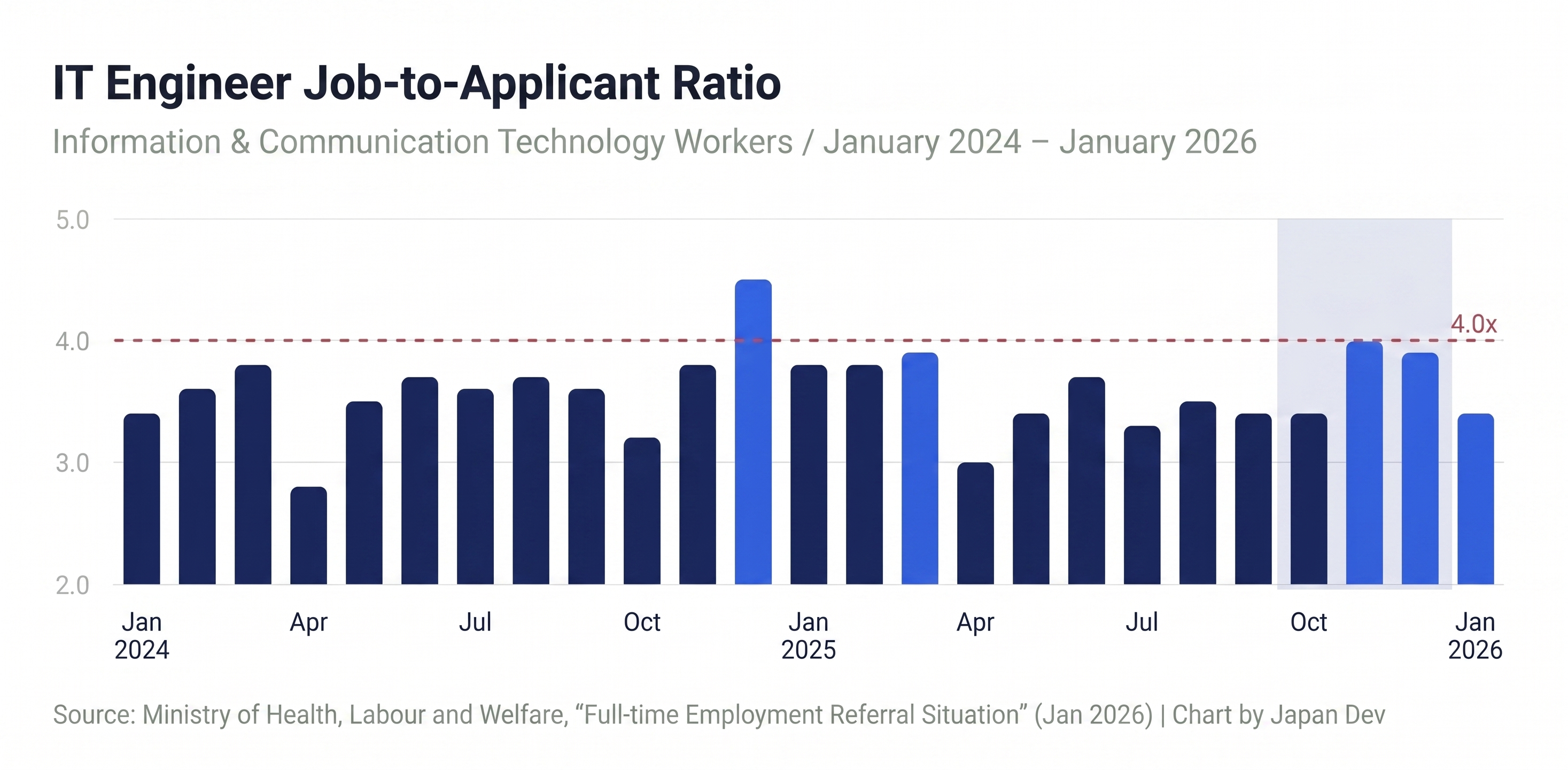
Source: Ministry of Health, Labour and Welfare
And yet, some companies manage to consistently attract skilled international engineers, even without a famous brand name or a big recruiting budget.
The Japan Dev team has reviewed job postings for more than 250 companies and operates a platform viewed by 600,000+ engineers every month. We find that the difference usually comes down to how the job post is written.
This guide will explain how to write a job post that stands out, especially to engineers who have experience, options, and know how to evaluate jobs.
3 Key Points: Writing Job Posts for Global Engineers
Keep the tone friendly
Overly formal language creates distance. On the other hand, being too casual can make the position or company seem unprofessional.
The key is to find a balance and create text that is friendly, clear, and concise.
Use first-person language to keep the language personable, for example, "we" or "our team". Think of a job post as the candidate’s first impression of your company.
Understand the role before you write about it
The most effective job posts are created through a team effort between HR teams and engineering managers.
Each brings an essential perspective to the job post:
Engineering Manager |
HR |
|---|---|
Understands the role, tech stack, and required seniority level |
Can articulate company strengths, culture, and the "why join us" message |
This combined point of view helps communicate what’s actually unique about the role and makes your company stand out. This is much better than just listing the generic requirements.
Write in English
Most bilingual international engineers find it easier and faster to read in English, even when a role requires business-level Japanese. Writing in English also signals that your company is serious about building an international team.
But if you choose to include both languages in the job post, we recommend always putting English first.
So who should be writing the job posts?
Ideally, a native level English speaker who is knowledgeable about engineering.
AI tools such as ChatGPT, Gemini, and Claude can help translate Japanese job descriptions into natural English. But it’s best to always have a native speaker run a final review before publishing! The goal should be to make sure it reads naturally and resonates with English-speaking candidates (not just pure text translation).
|
For reference, we’ve created this AI prompt to help rewrite your Japanese job descriptions into natural English! |
Why You're Not Getting Applications: Ambiguity Is Costing You
After reviewing job posts from 250+ companies hiring in Japan, we find that a common cause of low application rates is not purely due to low compensation or an uninteresting role. It's often more about lack of clarity.
For example, does your job post have any of the following?
Salary listed as "negotiable" or left blank
Vague Japanese requirements ("business-level Japanese" with no further explanation)
Leave remote work availability as "flexible" or "to be discussed"
These are relatively major details. If you don’t have a clear stance on these criteria, applicants will most likely think "this company is hiding something". And the best engineers, especially those who have multiple options, will move on.
Another common problem: listing 10+ requirements. This often shows that the company hasn't thought clearly about what the specific role needs. Experienced engineers will be comparing your job requirements against other job posts, and a long list of requirements won’t really help.
It might take some effort, but honesty and specificity about what you offer to employees will have a more positive impact on application rates.
In the following sections, we'll explain how to communicate these details effectively.
Job Descriptions: Essential Elements & Our Recommended Order
Job posts that attract international engineers should include all the essential information. We’ve added some recommended details that can help your company stand out from others.
The table below outlines the recommended structure and highlights the key points for each section.
# |
Section |
Type |
What to write and key points |
|---|---|---|---|
1 |
Job title |
Required |
English only, short and clear at a glance. No coding language or location in the title. |
2 |
About the Role |
Required |
Team mission, your impact, why this is interesting (in 2–3 sentences). Include numbers and cover technical challenges here. |
3 |
About the Team |
Recommended |
Team size, composition, how you work, level of autonomy. "Who you will work with" is as important as salary. |
4 |
Responsibilities |
Required |
What the engineer will do. Include bullet points starting with action verbs (ex. design, build, lead), list 5–6 items in order of priority. |
5 |
Requirements |
Required |
Focus only on essential skills. Keep the list short and remember that unrealistic requirements reduce applications. |
6 |
Tech stack |
Recommended |
List in full, right after Requirements. Engineers tend to filter jobs by tech stack. |
7 |
Nice to have |
Required |
Separate clearly from Requirements. Many strong engineers will not apply if they don’t meet all requirements. Make it clear that this is preferred, and not a hard requirement. |
8 |
Japanese language requirements |
Recommended |
Specify required level (JLPT / CEFR), specific use cases, and when Japanese is not needed. Listing "Business-level Japanese" with no explanation will discourage skilled candidates from applying. |
9 |
Compensation |
Required |
Show a salary range. If the information is not public, clearly state that it will be shared during the initial interview. Writing “competitive salary” or “TBD” does not offer any concrete information. Adding a salary range increases applicant numbers by 15% (according to Japan Dev data). |
10 |
Hiring process |
Required |
Make every step of the process clear, with estimated timelines. Commit to sharing salary before any technical assessment. |
11 |
Work environment |
Recommended |
Include exact office days, location, hours. "Hybrid" or “Negotiable” alone is not enough. If remote work is not available, state that clearly and honestly to reduce mismatches and maintain higher retention rates. |
12 |
Career path |
Optional |
Show technical and management career tracks, 3–5 years out. This will give applicants a clear image of what it’ll be like to work at your company long-term. |
13 |
Role-specific benefits |
Optional |
Include learning support, equipment allowances, conference sponsorship for the specific role. Company-wide benefits (ie. insurance and commuting allowances) belong in your company profile. Too much information in the job post can make it harder for candidates to read. |
14 |
Relocation support |
Optional |
Visa sponsorship, relocation allowance, housing support. Being specific helps address a common concern for overseas candidates. If the same support applies to all positions, consider listing it in the company profile instead. |
Watch out for Duplicate Titles
It's common for companies to create separate job posts for a team when they're actively hiring. However, this is how the highest performing postings often appear in a candidate's search results:
Backend Engineer (Logging Infrastructure)
Backend Engineer (API Development)
Backend Engineer (Data Integration)
If possible, consolidate the positions. Or, add a line to the top of the job description: "We have multiple openings for this role across teams. Apply to the closest match and we will discuss team fit during the interview process."
About the Role
This section will determine whether an engineer applies to the job or not. Answer the following three things in 2–3 sentences:
Team mission and the problem this team is solving
The scale and impact of this specific role (data like user/request numbers help)
What makes this role interesting? Include any future challenges that will keep engineers engaged and learning.
✅ Good example |
❌ Avoid this |
|---|---|
“This team is responsible for systems that process more than 50 million API requests per day. Within the next two years, the system is expected to scale by 10x. You will play a key role in designing and building the core architecture that makes this growth possible.” |
"You'll contribute to our product development and support the company's growth alongside the team." → Engineers can easily recognize this kind of generic statement as a template that could apply to any company. It conveys very little meaningful information and does not differentiate the role. |
Responsibilities: Key Points for Attracting More Applicants
The "About the Role" section explains why the role matters. The “Responsibilities” section explains what the engineer will do. This is crucial to helping the candidate understand if they will fit into this role or not.
When writing this section, keep in mind to:
List responsibilities in order of priority, with the most important work first.
Start every bullet point with an action verb: Design, Build, Lead, Own, Collaborate, etc.
Avoid vague or abstract wording.
Keep the list at 5–6 items. More than 10 signals unclear direction.
✅ Good examples |
❌ Avoid these |
|---|---|
“Design and implement scalable backend services supporting 50M+ API requests daily” |
“Be involved in system development and operations” |
“Lead architecture decisions end to end — API design, data modeling, performance optimization” |
“Contribute to team efforts and help improve the product” → could describe any engineer at any company |
Required Skills: How to Write Clear Requirements
We recommend listing only what is truly essential in the “Requirements” section. A candidate should be able to read your requirements and immediately know whether they qualify or not.
✅ Good example |
❌ Too vague |
|---|---|
Backend development experience using Java, Kotlin, or Go (3+ years of experience) |
Web application development experience |
Avoid asking for unrealistic requirements like "responsible for development, infrastructure, and management”, or “5+ years of leadership experience with newly emerged technology”. These expectations are often disconnected from the realities of the hiring market, and can reduce your applicant pool significantly.
Translate Soft Skills into Specific Behaviors and Experiences
Abstract terms such as "communication skills" or "flexibility" don't communicate what you're actually looking for in a candidate. It's easier for the applicants to understand when you describe these qualities in the context of specific situations when involved in the role.
✅ Good example |
❌ Too vague |
|---|---|
Experience working with engineers, PMs, and designers daily to move development forward |
Good communication skills |
Ability to proactively share updates and ask clarifying questions in async or remote environments |
Flexible mindset |
Experience guiding team members through code reviews and technical decision-making |
Leadership skills |
Separating Preferred Skills from Required Skills
Even when a skill is listed as "preferred," many engineers might see it as a requirement and assume they shouldn't apply unless they meet it.
A report by LinkedIn Talent Solutions found that women, in particular, are more likely to not apply unless they believe they meet 100% of the qualifications.
You can encourage qualified engineers to apply by clearly separating “Required” qualifications from your “Preferred” skills.
Other Details: Ensure Transparency and Clarity
Japanese Language Requirements
Listing requirements such as "Business-level Japanese" or "JLPT N2 or above" doesn’t give candidates a clear understanding of the actual level of Japanese proficiency needed for the role.
Explain the situations in which Japanese will be used on the job. Providing context or examples will help candidates judge whether their language skills match the position’s requirements.
Examples of language requirements:
Business-level Japanese (JLPT N2 / CEFR B2 minimum)
Used for: daily Slack with Japanese-speaking PMs, weekly all-hands, written PRD reviews
Not required for: code reviews and design documentation
Providing this level of detail helps define whether fluent, near-native Japanese is required and what level of proficiency is actually acceptable. As a result, engineers can better determine whether they're a good fit for the role and decide whether to apply.
Including CEFR Level Requirements for More Clarity
CEFR (Common European Framework of Reference for Languages) is a widely used international standard for measuring language proficiency. It assesses listening, reading, speaking, and writing skills across six levels, ranging from A1 (beginner) to C2 (proficient).
Metric |
What it measures |
Levels |
Characteristics |
|---|---|---|---|
JLPT |
Reading and listening only |
N1–N5 |
The JLPT is designed specifically for Japanese language learners. It evaluates only listening and reading comprehension, not speaking or writing skills. |
CEFR |
Reading, listening, speaking, writing |
A1–C2 |
The CEFR framework more accurately reflects the language abilities required in actual day-to-day communication. |
Modern tech companies like Mercari are increasingly adopting CEFR for Japanese proficiency requirements. Since many international engineers are familiar with CEFR, it communicates expectations more clearly.
How to Handle Japanese Language Requirements
Japanese language requirements are one of the factors that international engineers pay the closest attention to when applying to jobs. Whether or not Japanese proficiency is listed as a mandatory requirement can have a significant impact on the number of applications a position receives.
Unless Japanese is absolutely necessary for the role, we recommend listing it as a preferred qualification rather than a requirement. Adding a brief explanation about the situations in which Japanese might be used can help lower the barrier to applying, but still give candidates a clear understanding of the level of proficiency needed for the position.
Compensation
According to Japan Dev data, job postings listed with a salary range receive around 15% more applications than those without.
The reason is simple. Engineers do not want to spend time in a job application process only to discover a salary mismatch mid-way through.
✅ Recommended format for salary range:
- Base Salary
● Junior (0–3 years): ¥4,000,000 – ¥6,000,000
● Mid-level (3–5 years): ¥6,000,000 – ¥8,000,000
● Senior (5+ years): ¥8,000,000 – ¥10,000,000
- Bonus: 2 times/year, equivalent to a total of two months' salary
- Stock Option (SO): Available
❌ Phrases to avoid:
Phrase |
Reason to Avoid |
|---|---|
"Competitive salary" |
This is used by every company. It provides no information and may make engineers wonder if you’re hiding a low number. |
"Negotiable" / "To be discussed" |
Creates anxiety about being lowballed. Raises the barrier to apply. |
¥4,000,000 – ¥10,000,000 |
A range this wide implies that the company is not clear on the applicant skill level, and creates uncertainty around skill assessment and appropriate compensation. |
|
⚠️ If You Can't Disclose Salary Ranges, Here are 3 Alternatives
¥8M+ (full compensation details will be shared during the initial interview)
"Salary range shared before any technical assessment, typically in the first 30-minute interview." ✔ What engineers fear most is discovering a mismatch in compensation expectations after investing significant time in the hiring process. That's why it's important to clearly state when salary details will be shared, ideally before any technical assessment.
Instead of saying "competitive salary," provide candidates with a benchmark that shows where your compensation stands relative to the market. Example: "Benchmarked against the top 25% of Tokyo's engineering market. Range provided on the first interview." |
If your company is able to provide these extra details about engineer compensation, it can make a huge difference in a candidate’s decision to apply to your jobs.
Hiring Process
As competition for engineering talent increases, skilled candidates are increasingly keen to avoid hiring processes that lack transparency. In particular, information about coding assessments and take-home assignments is an important factor in a candidate's decision to apply. We recommend providing these details as clearly as possible, such as whether the tests are required, how much time they typically take, and the criteria.
Example format:
Document Screening (3–5 business days)
Casual Interview / Japanese Language Check (30 min, online)
First Interview (60 min, online)
Second Interview (60 min, online)
Reference Checks (3–5 business days)
Final Interview (60 min, online or in-person)
Job Offer Meeting
* The hiring process is subject to change.
* All interviews can be conducted online.
Providing this information helps increase application rates, and also decreases the likelihood of candidates dropping out partway through the hiring process.
Additional Tips For Increasing Application Rates: Using Job Descriptions and Company Profiles Effectively
In addition to the information covered above, it can also help to highlight your company’s unique strengths, and work environment.
Job Post vs. Company Profile
On Japan Dev, your company is presented in two places: the job description and the company profile. It's important to understand the role that each one plays in order to decide what information belongs where.
Type |
What to Include |
Examples |
|---|---|---|
Job Post |
Role-specific information |
Job responsibilities, career path, role-specific benefits (ex. learning budget, equipment, conference support) |
Company profile |
Company-wide information |
Working hours, employee benefits (health insurance, commuter allowance), engineering team structure & culture |
Putting all your company profile information on the company profile page will help keep the separate job descriptions focused only on the role and its requirements. This helps candidates skim through and evaluate job opportunities more quickly.
In the sections below, we'll cover the types of additional information that belong in a job description, followed by the information that is best suited for a company profile.
Additional Information to Include in Job Descriptions
Including the following directly in the job description can increase a candidate's interest in applying.
Work environment
Information about remote work availability, expectations around in-office work, and work location are some of the most important factors engineers consider when reviewing a job post. When this information is unclear, candidates will feel uncertain about the role, making them less likely to apply.
Below are some examples on how to present this information based on different scenarios:
For On-Site Roles
Include not only the office location, but also the nearest train station.
If remote work is possible depending on the circumstances, clearly state the flexibility available: "Remote work can be discussed for candidates with special circumstances."
For Hybrid Roles
Saying only "hybrid work" can lead candidates to assume that they are expected to be in the office 4 days a week. We recommend providing more concrete details, such as the following:
How many days per week employees are expected to work from the office
Whether office days are fixed or flexible
Whether teams can coordinate their own in-office schedules
For Fully Remote Roles
It's important to let applicants know about not only the flexibility offered, but also any restrictions, if applicable.
Eligible work locations (i.e., within Japan only, or overseas work permitted)
Preferred time zones if working from outside Japan
Whether any regular office visits are required
|
Note: Even if the role is currently fully remote, it's important to clearly state in the job description if office attendance may be required in the future or at specific times. |
Career Growth Opportunities
Skilled candidates want to understand how they can grow within a company and what their long-term career trajectory might look like. Because career paths often differ from one role to another, this information is best included in each individual job description.
Timeframe |
Example Milestone |
|---|---|
First few years |
Senior Developer: technical leadership, hands-on architecture decisions |
Around 5 years |
Team Lead: managing a small team while staying technically involved |
Long term |
Architect: driving technical strategy across the product |
Outlining the candidate’s potential career growth in the position over the next five years is an effective way to help candidates envision a long-term future with your company.
Role Specific Benefits and Perks
Company wide benefits, such as health insurance, commuting allowances, and paid leave, are best included in the company profile. On the other hand, if a role comes with unique benefits or special perks that are not available across the organization, highlighting them in the job description can help increase more applications.
Examples of Role Specific Benefits to Highlight in the Job Description:
Professional Development Budget (i.e., up to ¥100,000 annually for books, online courses, and certifications/exams)
Conference Attendance Support (i.e., full coverage of registration fees for one major conference per year)
Equipment Allowance (i.e., a MacBook Pro provided by the company, or a dedicated equipment budget of X yen.)
Role Specific Relocation Support
If visa sponsorship or relocation assistance (i.e. travel expenses covered) is offered only for specific roles, we recommend clarifying this in the job description.
If the relocation support applies to the entire company, it’s best to include it in the company profile.
What to Include in the Company Profile
These are company-wide details that apply to all positions. Including them in your company profile helps emphasize the strengths of your engineering organization as a whole.
Team Structure and Engineering Culture
Provide information that helps engineers understand what kind of team they'll be joining and how they will work on a day-to-day basis.
We recommend including the following details:
Team size and structure
The company's working languages and whether there are international team members
Development tools and methodology (i.e., Agile, Scrum)
Code review and deployment processes
How technical decisions are made
Team values, such as approaches to code quality, learning from failures, and continuous improvement
If a role operates within a different team structure or development process, we recommend adding role specific details to the job description.
Relocation Support
For international engineers, information about visa sponsorship and relocation support is a major component when evaluating a job opportunity.
Candidates tend to look for answers to the following:
Can I apply from overseas?
Does the company provide support for getting or renewing a work visa?
Is there any relocation assistance, such as support for travel expenses, help with housing search, or moving costs?
If visa sponsorship and relocation support are offered across the company, we recommend including this information in your company profile. This allows you to highlight it as a company-wide benefit across all job postings.
Skills Development Opportunities
Candidates will want to know how a company supports employee growth. Putting an emphasis on this can differentiate your company’s values.
Consider highlighting:
Whether employees receive an annual learning and development budget
Internal and external training programs, seminars, and workshops
Mentorship programs and regular one-on-one meetings
|
Why tech professionals change jobs: while higher compensation is the most common reason (38%), a lack of training and growth opportunities (33%) is nearly as significant. This suggests that opportunities for professional growth and skills development are valued almost as highly as compensation. Source: TechRepublic |
It's also a good idea to highlight opportunities for growth in day-to-day work, not just formal programs and policies:
Opportunities to work with and learn new technologies
On-the-job training (OJT) and structured support for skill development
Challenging projects planned for the future
Working Hours
Flexible working hours and discretionary work systems are common in engineering roles. A description stating that “work hours are from 9:00 am – 6:00 pm" doesn't provide enough information about the actual working style.
If possible, we always recommend clearly explaining the level of flexibility employees have with their work hours. This includes details such as whether the team works with core hours and how flexible working hours are applied.
If the working hours policy is standardized across the entire engineering organization, we recommend including it in the company profile rather than repeating it in every job description.
Common Mistakes
Describing the "Ideal Candidate": Avoid Vague Wording
In Japanese hiring practices, it’s common to include an “Ideal Candidate” section.
We generally don’t recommend simply translating and including a section called "Ideal Candidate". While these descriptions are natural and common in Japanese job posts, they often become vague and difficult to interpret when translated into English.
But if you must include this section, avoid vague descriptions such as "strong communication skills" or "highly self-motivated." Instead, describe specific behaviors and expectations that are directly tied to the role and day-to-day work.
Holiday and Vacation Time
For English speakers, the word "holiday" typically refers to public holidays such as Christmas, New Year's, or Golden Week. Phrases like "Work Holidays: Saturday, Sunday" can sound unnatural and may create confusion.
If you want to state that employees are not expected to work on weekends, it's generally better to communicate this within the "Work Schedule" or "Working Hours" section, instead of under the "Holiday" section.
Example:
Work Schedule |
Holidays/Vacation |
|---|---|
|
- Monday - Friday - Flex time (8 hours/day) - Core hours: 10:00–16:00 |
- 10 days paid leave after 6 months (increases by 1 day/year per Japanese labor law) - All Japanese public holidays - Summer leave: 3 days - Year-end / New Year leave: 4 days |
FAQ
What Makes a Job Post Attract More Applicants?
Job posts that get a high number of applicants usually have a few things in common.
Jobs that are open to candidates living outside Japan and do not require advanced Japanese proficiency tend to attract a larger talent pool, which leads to more applications.
Of course, application numbers are also influenced by other factors, such as the required skills, the appeal of the company and its in-house products, and overall company brand recognition.
What Do Engineers Look for in a Job Post?
We analyzed click data from Japan Dev's job search filters and found that the following criteria receive the most attention on our site.
Rank |
Filter |
What it tells us |
|---|---|---|
1 |
Visa sponsorship |
"Can I even apply?" is always the first question for candidates |
2 |
Japanese language level |
Is the language requirement a barrier for me? |
3 |
Remote work |
How flexible is the working arrangement? |
4 |
Skill level |
Does this job post fit my experience level? |
5 |
Salary range |
Is compensation transparent? |
|
💡 Engineers usually check to see if they can even apply first, before evaluating fit. Visa sponsorship, Japanese requirements, and remote policy are the three things to make crystal clear. |
Japan Dev Job Posting Templates
Based on the best practices that we’ve introduced so far, we’ve prepared a sample of an effective and attractive job description, for your reference.
The sample is available and downloadable via Google Docs, in both Japanese and English.
Please note: This sample is provided for reference purposes only. Please make sure to customize the content to your hiring goals, requirements, and the key message you would like to communicate to candidates about your company.
Summary: Final Checklist
A job post is often a candidate's first impression of your company.
By taking into consideration the points that we introduced and making a few thoughtful adjustments to how you present the role, you can significantly change the quality of candidates that you attract.
Before publishing your job post, take a moment to review the following checklist:
Checklist |
If you’re actively hiring international engineers in Japan, we encourage you to start by reviewing your existing job posts. We hope these tips help make your hiring efforts even more successful!
Ready to start hiring global engineers?
Japan Dev is one of Japan's leading job platforms for international software engineers, attracting more than 600,000 monthly page views. Over 250 companies have already used Japan Dev to build and grow their global engineering teams.
What we offer:
Platform with 600,000+ page views/month, reaching a large audience of engineers
Support with creating Company Profiles to showcase your engineering culture
HR-focused blog content and engineer-facing articles to build brand awareness
YouTube content to share authentic stories and perspectives from international engineers in Japan
Youtube: youtube.com/@japan-dev
Sample Company Profile: japan-dev.com/companies/money-forward
HR-focused Blog (mainly Japanese): japan-dev.com/blog-employer
Engineer-focused Blog: japan-dev.com/blog
👉 Start hiring global engineers today! Contact us here!


Eric Turner
Eric is the co-founder of Japan Dev. He moved from the US to Tokyo in 2013 and spent the next eight years writing code at Japanese tech companies — VASILY, Gunosy, and Recruit — before becoming an Engineering Manager at Mercari, where he hired and leveled software engineers himself. He started Japan Dev because he kept meeting brilliant developers who had taken the wrong job in Japan simply because nobody told them what a good offer looked like. Japan Dev now works with 250+ Japanese tech companies. This guide comes from reviewing job posts directly, including the data on what makes engineers click "apply" and what makes them move on.
- Delivery Manager, LINK Ecosystem
- Moneytree
- Remote
- ¥8M ~ ¥10M
- Software Engineer – Open Position (Robotics / Backend, C++)
- Mujin
- Tokyo
- ¥8M ~ ¥15M
- Senior Software Engineer, Satellite Operations System Development...
- Axelspace
- Tokyo
- ¥6M ~ ¥9M
- Senior DevOps Engineer - Build Systems & CI
- Mujin
- Tokyo
- ¥10M ~ ¥13M



Latest Tech Jobs 🇯🇵
Explore the top developer jobs in Japan for foreigners
- Delivery Manager, LINK Ecosystem
- Moneytree
- Remote
- ¥8M ~ ¥10M
- Software Engineer – Open Position (Robotics / Backend, C++)
- Mujin
- Tokyo
- ¥8M ~ ¥15M
- Senior Software Engineer, Satellite Operations System Development...
- Axelspace
- Tokyo
- ¥6M ~ ¥9M
- Senior DevOps Engineer - Build Systems & CI
- Mujin
- Tokyo
- ¥10M ~ ¥13M
- Senior Product Engineer (Partner Product Development Department)
- Money Forward
- Tokyo
- ¥6.9M ~ ¥10M
- Senior Software Engineer
- MeetsMore
- Tokyo
- ¥7.5M ~ ¥10M
- Senior Backend Engineer
- Tokenz
- Tokyo
- Senior Accounting Engineer / 財務データ基盤エンジニア
- KOMODO
- Tokyo
- Tech Lead Engineer (Voice/Speech)
- Geniee
- Tokyo
- ¥7M ~ ¥16M





Get Job Alerts
Sign up for our newsletter to get hand-picked tech jobs in Japan – straight to your inbox.

© 2026 Japan Dev. All rights reserved.
Proudly built in Tokyo.


Curated with 💙 in Tokyo
All our data is gathered from publicly available sources or contributed by users