



Updated October 2, 2026
Medicine for Children in Japan: A Parent's Guide to Prescriptions and OTC Drugs


As someone who’s raising a child in Japan for the first time, small things can catch you off guard. Medicine is one of them.
If you’re new to Japanese healthcare, you might be surprised to see that fever medicine for kids in Japan usually comes in powder form, but you can also find it as a syrup and dry syrup, tablets, and suppositories. The same goes for most other medicines, for that matter.
But how do you use it if your child is not a fan, and where do you get it from?
I’ll answer these two questions plus cover everything else you might want to know about Japanese medicine for children. Just one quick note: we’re not medical professionals, and this article should only serve as a reference. For medical advice, speak with your child’s doctor or pharmacist.
In this article: 📝
How Japanese Clinics Prescribe Medicine for Children
The first thing you should know is that when children and babies get sick in Japan, parents usually take them to a local 小児科 (shonika) clinic, which is different from a hospital (病院).
You’ll usually need both your iryosho and your insurance, whether that’s National Health Insurance or Social Health Insurance, to receive free or discounted child medical care in your area.
Looking for a pediatric clinic? See our guide to finding an English-speaking pediatrician in Japan.
What Formats Do Japanese Clinics Prescribe?
Japanese clinics prescribe children's medicine in three main formats:
Powder (粉薬, konagusuri)
Syrup or liquid medication (シロップ, shiroppu)
Suppositories (座薬, zayaku)
The format depends on age, weight, symptoms, and the drug itself. That’s why cough medicine for kids in Japan, for example, may look different from one child to the next.

What is Powder Medicine in Japan?
Powder medicine (粉薬, konagusuri) is the standard prescription format for children in Japan. It’s very convenient to use because it’s dispensed in individual single-dose sachets (分包, bunpou), meaning you receive pre-packed doses when you buy it from the pharmacy.
The pharmacy takes your kid’s weight and age into consideration when preparing the doses.
Then, you simply open one sachet per dose and give the entire thing to your kid, no measuring cups or scales needed.
This makes it easy to take the medicine on the go. You can put a few packets in your bag and know each one already contains the right amount.
Why Powder Instead of Tablets or Liquid?
Powder medicine is common in Japan partly because there’s no regulatory mandate for pediatric tablet formulations.
Compounding from adult doses is the normal way they prepare medicine for kids here, which allows doctors and pharmacists to adjust the amount exactly to a child’s weight without waiting for dedicated child formulations. They mix crushed tablets with sucrose or starch and keep them ready for use.
As a result, and as stated in this 2022 review in PubMed Central, powder became the go-to option, and surveys show it’s prescribed for over 70% of children under 10 years old.
Types of Children's Medicine Japan
Now, let’s help you make sense of the most common medicine prescribed for children in Japan. Please note that an adult version of this medication is also available under the same name, so make sure to pick the children's version.
Fever and Pain Medicine
For fever and pain, Ibuprofen is not recommended for young children in Japan. Medicine with acetaminophen is a common choice, the most popular option being Children’s Bufferin.
You can find it as Children’s Bufferin CII and Children’s Bufferin Chewable. Both are caffeine-free and made for ages 3 to under 15. The former come as small fruit-flavored tablets that can be easily swallowed by kids, while the chewable version uses orange-flavored tablets that can be taken without water.
There’s also Bufferin Junior Cold Medicine A, easy-to-swallow tablets used for various cold symptoms like sneezing, cough, phlegm, runny nose, phlegm, and so on. These tablets are made for ages 5 to under 15.
Cough Medicine
If your child has a cold with a cough, Pabron Kids is caffeine-free over-the-counter cough-medicine (鎮咳薬, chingaiyaku) made for children of different ages that also helps with runny nose, fever, sore throat, phlegm, stuffy nose, sneezing, chills, headache, joint pain, and muscle pain.
It comes in 3 forms:
Strawberry-flavored syrup: Children usually like the sweet taste, so it’s one of the more convenient options. Perfect for those over 3 months old.
Strawberry-flavored granules: These can be given to kids over 1 year old and are usually well-liked in terms of flavor.
Glacecoat® tablets: Small tablets that can be easily swallowed by kids. Coated with sugar for a sweeter taste.
Runny Nose Medicine
For a runny or blocked nose, Uzu Children’s Rhinitis Syrup A is made for symptoms linked to acute rhinitis, allergic rhinitis, and sinusitis. It comes in a grape flavor, and the formula is sugar-free and caffeine-free.
Antibiotics
Antibiotics (抗生物質, kōseibusshitsu) are prescription-only, and once a doctor prescribes them, your child needs to finish the full course. Just watch for side effects like rash or diarrhea, and call the clinic if they appear to receive proper medical care.
Probiotics
Probiotics (整腸剤, seichozai) are often prescribed along with antibiotics. Shin Biofermin S Tablets contain three lactic acid bacteria strains, and are mainly used for intestinal regulation, soft stools, constipation, and abdominal fullness.
The tablet form is for ages 5 and up, while the granule form can be given from 3 months of age.
Suppositories
Suppositories (座薬, zayaku) are a good alternative for infants who can’t keep oral medicine down. Doctors recommend them for high fevers or when vomiting occurs, and they usually start working within 30 to 60 minutes.
How to Give Children's Medicine in Japan
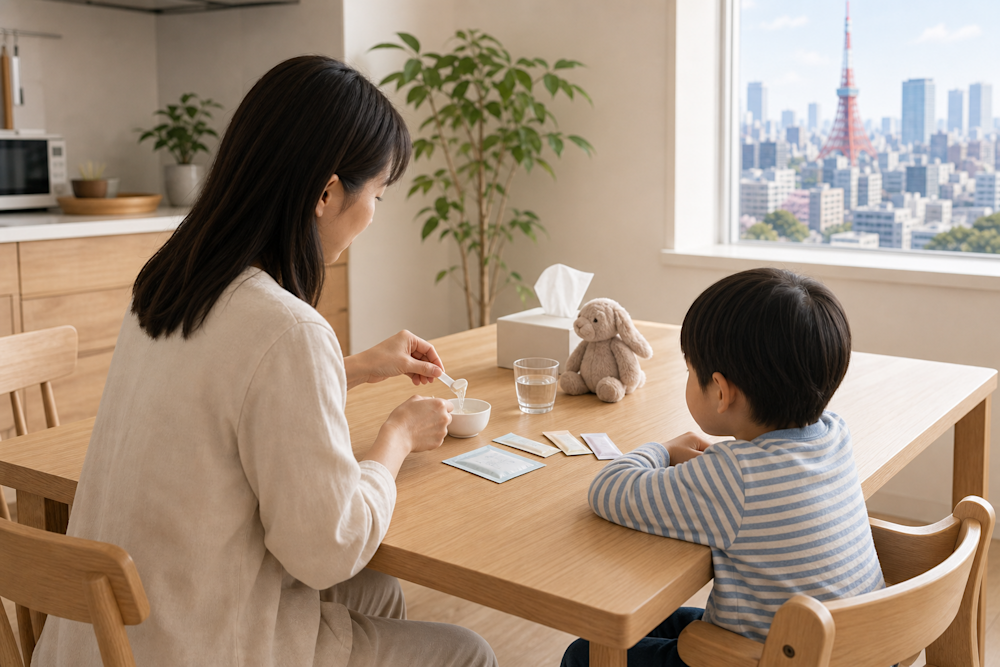
Giving medicine to a young child can test any parent's patience, so here are some methods that’ll help you do this with less struggle while keeping things safe.
Giving Syrup Medicine
Start by gently shaking the syrup bottle so that all the ingredients are combined. And since syrups for children are usually sweet, you can give it as it is, without mixing it with foods or drinks.
If your kid is old enough to drink from a glass, you can give them their dose straight from a measuring cup or spoon. Otherwise, you can use a dropper or plastic syringe, so ask for one of these tools while at the pharmacy.
If you’re using a syringe, point the tip toward the inside of the cheek instead of the back of the throat, then give the medicine in small pushes so your child has time to swallow. If your child spits some out, don’t give them more. Instead, call the clinic or the pharmacy to ask what to do next.
Giving Powder Medicine - The Paste Method
For powdered medicine, many Japanese parents use the paste method, known locally as ペースト法. This is a common method used for babies under 1 year old.
Making a paste is simple: take one dose of the powdered medicine, add a little bit of water, usually a few drops, and mix it into a thick paste. Then, using your finger, place it on the inner cheek or the back part of the tongue, and that’s it!
Mixing Powder Medicine with Food
If the taste is unpleasant, you can mix the paste into your kid’s favorite soft food, like a small amount of yogurt, applesauce, chocolate-flavored syrup, or ice cream. This will mask the taste of the powder, just make sure to use small amounts of food so your kid can eat it in one go.
If your kid still refuses to take it and you think giving them something tasteless will do better, you can use oblate (オブラート) as a last resort. This is a thin, edible starch film made from rice starch. Japanese families sometimes wrap powder inside it like a small packet, which can then be easily swallowed with some water.
What NOT to Mix with Medicine
Some medicines have clear mixing warnings, so check the label before you stir a dose into foods and drinks of your choice. For example, acidic drinks like apple juice or orange juice can remove the sweet coating of some meds, leaving a bitter taste in your kid’s mouth.
You also shouldn’t mix medicine into foods and drinks your kid eats daily, like rice or milk. This is because they can start associating them with medication and refuse to eat them after they stop taking the medication.
You should avoid giving honey to infants under 1 year, because they may develop infant botulism after consuming it. This also goes for drinks and sweets that contain honey.
Reading the Medicine Label (Key Japanese Terms)
Medicine labels in Japan can be confusing, especially if your Japanese is not that good, so here are some key terms to look out for.
Dose Frequency and Timing
Three times a day - 1日3回 (ichinichi sankai)
Before meals - 食前 (shokuzen)
After breakfast - 朝食後 (choushokugo)
After lunch - 昼食後 (chuushokugo)
After dinner - 夕食後 (yuushokugo)
Before bed - 就寝前 (shuushinmae)
As needed - 頓服 (tonpuku)
Administration
Take with water - 水で飲む (mizu de nomu)
Dissolve in water and take - 水に溶かして飲む (mizu ni tokashite nomu)
Shake well before taking - よく振ってから飲む (yoku futte kara nomu)
Age, Weight, and Restrictions
For children - 小児用 (shouniyou)
For infants and young children - 乳幼児用 (nyuuyoujiyou)
Age limit - 年齢制限 (nenrei seigen)
Weight limit - 体重制限 (taijuu seigen)
Do not give to children under ___ - ___歳未満は服用しないこと (___sai miman wa fukuyou shinai koto)
Ask a doctor - 医師に相談 (ishi ni soudan)
Ask a pharmacist - 薬剤師に相談 (yakuzaishi ni soudan)
Storage
Cool dark place - 冷暗所 (reiansho)
Refrigerate - 冷蔵保存 (reizou hozon)
Store at room temperature - 室温保存 (shitsuon hozon)
Avoid direct sunlight - 直射日光を避ける (chokusha nikkou o sakeru)
Avoid high temperatures - 高温を避ける (kouon o sakeru)
Keep out of reach of children - 子どもの手の届かない所に保管 (kodomo no te no todokanai tokoro ni hokan)
Keep tightly sealed - 密封して保管 (mippuu shite hokan)
Over-the-Counter Children's Medicine at Japanese Pharmacies
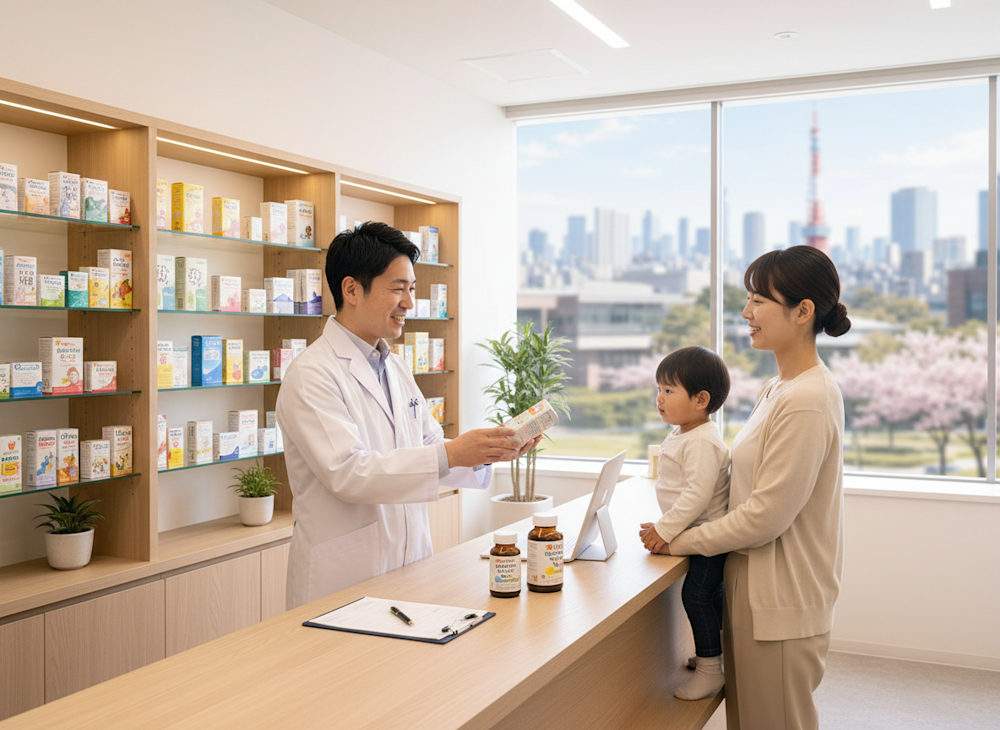
If your child feels warm, coughs, or has a runny nose, OTC medicine can help. That said, these meds work best as a first step, not as a substitute for a doctor when symptoms drag on or look severe.
Fever Medicine in Japan for Kids
Children's Bufferin (ages 3-15) is the go-to choice for fever and pain. You can find it in most Japanese pharmacies as both easy-to-swallow tablets and chewable tablets, in flavors that kids enjoy.
We recommend keeping a pack at home because fevers can appear suddenly, especially at night, so it’s best to be prepared.
If a child won’t take tablets or is vomiting, Children’s Pabron Suppositories (ages 1-12) are another option. They’re meant for fever reduction only, so they don’t cover symptoms like headache or sore throat.
For older children, Norshin Acetaminophen Tablets (ages 7 and up) are also effective in reducing fever and can be found in many pharmacies here.
Cough and Cold Medicine in Japan for Kids
Bufferin also offers cold tablets for various cold symptoms, including cough, that go by the name Bufferin Junior Cold Medicine A (ages 5-15). Pabron Kids Cold Tablets (ages 5-14) is another medicine you can easily find that covers a variety of cold symptoms.
For younger kids and infants who dislike swallowing tablets, Kids Bufferin Cough Syrup S (ages 3 months-8 years) and Pabron Kids Cold Syrup (ages 3 months-7 years) are other effective options for coughs and phlegm.
For babies and young children who need a non-oral option, Vicks VapoRub can be used from 6 months of age and is applied to the chest, throat, or back to help ease symptoms such as nasal congestion and sneezing.
Just know that while these OTC meds can make a cold easier to manage at home, they won’t replace a medical visit that can sort out whether your child has a simple virus or a more serious infection that needs prescription treatment, which brings us to the next point.
Should You Get OTC Medicine or Visit a Clinic?
For mild symptoms, like a mild cough or a fever below 38.5°C (101.3°F), getting OTC medicine from a pharmacy will get you through the night and may save you an unnecessary clinic visit.
However, if the fever lasts for more than 3 days or reaches 39°C (102.2°F), or if your baby is under six months old and has any symptoms at all, go to a clinic or the emergency room at the nearest hospital straight away.
Young babies can lose fluids faster than older children, and they may not show clear warning signs early on. That’s why it’s safer to have a doctor check them sooner.
While we’re on the topic of emergencies, here are some emergency numbers you should have on hand, just in case.
FAQs
What Is Powder Medicine Called in Japanese?
The Japanese term for powder medicine is 粉薬 (konagusuri). It's dispensed in individual single-dose sachets called 分包 (bunpou). One sachet contains one dose, so you don’t need to measure it before giving it to your kid.
Why Does My Child’s Doctor Always Prescribe Powder Instead of Tablets?
Doctors prescribe powder because many young children can’t swallow tablets, plus Japan doesn't require companies to create special tablet versions for children. Compounding powders from tablets meant for adults is standard practice, not an exception.
What Types of Medicine Will My Child Be Prescribed in Japan?
Most children in Japan get powder medicine (粉薬, konagusuri), packed in single-dose sachets. Babies and younger children may get syrup (シロップ, shiroppu), or dry syrup (ドライシロップ, dorai shiroppu), which is powder that the pharmacy mixes with water. If a child can’t take medicine by mouth, doctors may recommend a suppository (座薬, zayaku).
How Do I Get My Child to Take Powder Medicine?
A common method is to mix the powder with a few drops of water to make a thick paste, then put the paste on the inside of the cheek or toward the back of the tongue. If the taste is a problem, mix it with a small amount of yogurt, chocolate syrup, or applesauce so your child finishes every bit.
How Do I Give My Child Syrup Medicine in Japan?
Use a measuring cup, a spoon, a dropper, or a plastic syringe, depending on your child’s age and preferred method. The easiest way is to use a syringe that the pharmacist will give you. Draw up the correct dose, point it toward the inner cheek, and release slowly. If your child spits some out, don’t give more right away. Call the clinic or pharmacist and ask what to do next.
What’s the Difference Between Syrup and Dry Syrup?
Liquid syrup (シロップ) comes pre-mixed, so you can give it as it is. Dry syrup (ドライシロップ) comes as a powder, so it needs to be dissolved in a small amount of water first. The pharmacist should explain this when you pick it up, or you can check the label.
How Do I Give a Suppository to My Child?
Store it in the refrigerator until you need it. Lay your child on their side and insert the rounded end gently into the rectum. Then hold the buttocks together for about 30 seconds so it stays in place. If the suppository slips out right away, you can insert another one. If more time has passed, it’s best to check with the clinic.
Can I Mix Japanese Powder Medicine With Milk or Juice?
Some medicines, like certain antibiotics, don’t mix well with dairy because it can change how the body absorbs the drug. Always check the label first or ask the pharmacist if you’re unsure.
What Should I Do if My Child Won’t Take the Medicine?
If your child won’t take the medicine, try the paste method. If that doesn’t work, mix the paste with a small amount of your kid’s favorite soft food, like yogurt, applesauce, chocolate-flavored syrup, or ice cream.
If your child keeps refusing it, don’t skip doses. Talk to the pharmacist or clinic, as they may have a better way to give it or another form of the same medicine. For more help, check the administration tips section above.
What Fever Medicine Is Used for Children in Japan?
A well-known fever medicine for children in Japan is Children’s Bufferin. It comes in two forms: as small fruit-flavored tablets that are meant to be swallowed, and as chewable orange-flavored tablets.
Final Thoughts on Children’s Medicine in Japan
Knowing how children’s medicine works in Japan will give you peace of mind, and that’s exactly what we hope to achieve with this article.
The most important things to remember are that powder medicine is common, as are syrups and dry syrups. If your child gets sick, you should go to a local shonika clinic, and if it’s after hours, the emergency room at the nearest hospital.
And when it comes to fever relief for young children, it’s safest to stick with acetaminophen, such as Children’s Bufferin, unless a doctor prescribes you another medicine.
- Robotics Data Engineer
- Omakase Robotics
- Tokyo
- Full Stack Engineer
- Omakase.ai
- Tokyo
- Machine Learning Manager, App SW
- Wayve AI
- Tokyo
- Principal Application Software Engineer
- Wayve AI
- Tokyo
- C++ Developer
- Rapyuta Robotics
- Tokyo




Latest Tech Jobs 🇯🇵
Explore the top developer jobs in Japan for foreigners
- Robotics Data Engineer
- Omakase Robotics
- Tokyo
- Full Stack Engineer
- Omakase.ai
- Tokyo
- Machine Learning Manager, App SW
- Wayve AI
- Tokyo
- Principal Application Software Engineer
- Wayve AI
- Tokyo
- C++ Developer
- Rapyuta Robotics
- Tokyo
- Software Engineer (Robotics Control Systems)
- Rapyuta Robotics
- Tokyo
- Global Remote Sensing Sales Engineer
- Axelspace
- Tokyo
- ¥6M ~ ¥8.5M
- Satellite System Integration Test Engineer
- Axelspace
- Tokyo
- Senior Product Engineer (Full Stack)
- Blued
- Tokyo
- ¥8M ~ ¥13M
- Senior Software Engineer
- Blued
- Tokyo
- ¥8M ~ ¥13M


Get Job Alerts
Sign up for our newsletter to get hand-picked tech jobs in Japan – straight to your inbox.

© 2026 Japan Dev. All rights reserved.
Proudly built in Tokyo.


Curated with 💙 in Tokyo by Eric Turner
All our data is gathered from publicly available sources or contributed by users