



Updated September 24, 2025
How to craft a great "Rirekisho", or Japanese resume [with template]
Before you apply for any jobs, the first step you’ll need to take is to create or update your resume. After all, your resume is the first impression you’ll leave before recruiters even get to meet you in person.
You might think that the content of your resume plays the biggest role here, but if you want to snag that interview, it’s also important to have a well-written and correctly formatted resume.
If the content is lacking, you can always make things shine a bit brighter with the right formatting. If the content is stellar, you don’t want it to go unnoticed. Either way, knowing how to correctly format your resume can help you tremendously.
But what if there isn’t one, unified resume format that’s “the right one?”
Unfortunately, this is the case with resumes. There are countless ways to prepare a resume, and you’ll find that each country and even each industry has a “correct” template for resumes that are generally followed and required from candidates.
This is why I wanted to write about the Japanese resume “rirekisho.” Many foreigners come to Japan looking for jobs, and most don’t even realize that their resumes are likely overlooked simply because the formatting isn’t right.
During your job hunt in Japan, if you want to have a real shot at finding a job, you’ll need a correctly formatted resume. In this article, I’ll help you understand what goes into preparing a good rirekisho and share my own template you can download and fill out.
Let’s start by explaining what the most widely accepted resume types in Japan are and what makes rirekisho different from the rest.
Accepted Resume Formats in Japan
In general, there are two types of accepted resume formats in Japan. The first type is called “rirekisho” (履歴書), as I mentioned, and the second type is called “Shokumukeirekisho” (職務経歴書).
Essentially, rirekisho is what you’ll generally use to apply to traditional Japanese companies. Think of it as a business card — that’s how common they are in Japan.
A rirekisho is usually kept short and concise and has a bullet point or a form-like style that includes only the most crucial information about you and your career.
As for the second type of resume, which is the shokumukeirekisho, you’ll realize that it’s more similar to a western-style CV. You have a wider opportunity to explain your experiences, talk about your interests and hobbies, etc., as it allows you to “sell” yourself better.
I’ll focus mostly on the rirekisho in this post, but if you want to know how to prepare a shokumukeirekisho, I have another post specifically for that. You can also find a good template there similar to the one I shared down below.
Should I Prepare an English Resume or a Japanese Resume?
While the format you should follow is mostly clear, you might be confused as to whether you should prepare your CV in English or in Japanese. After all, Japan is kind of a closed-off country in terms of culture and language, which means that not everyone speaks fluent English.
Therefore, if you’re applying to a traditional Japanese company where a decent level of Japanese is required, you’ll need to prepare your resume in Japanese.
While the times are changing, and more and more Japanese companies are opening up to receive job applications in English, you still need to keep in mind that not everyone speaks English well.
If you send your resume in English, it might also make it seem like you don’t trust your knowledge of Japanese, which may cause recruiters to not take your application seriously. So, even if you apply with an English resume, some companies might appreciate it if you send a Japanese rirekisho in addition. But this depends on the company.
If you’re applying to international companies such as the ones featured on the Japan Dev company list, or a recruitment agency that works internationally, you’re better off with a western-stye English resume.
How to Write a Japanese Resume: “Rirekisho”
Now that we’ve cleared up the crucial parts about resumes in Japan, let’s look at how you can prepare your very own rirekisho.
For reference, here is what the entirety of our rirekisho template looks like, which you can download below.
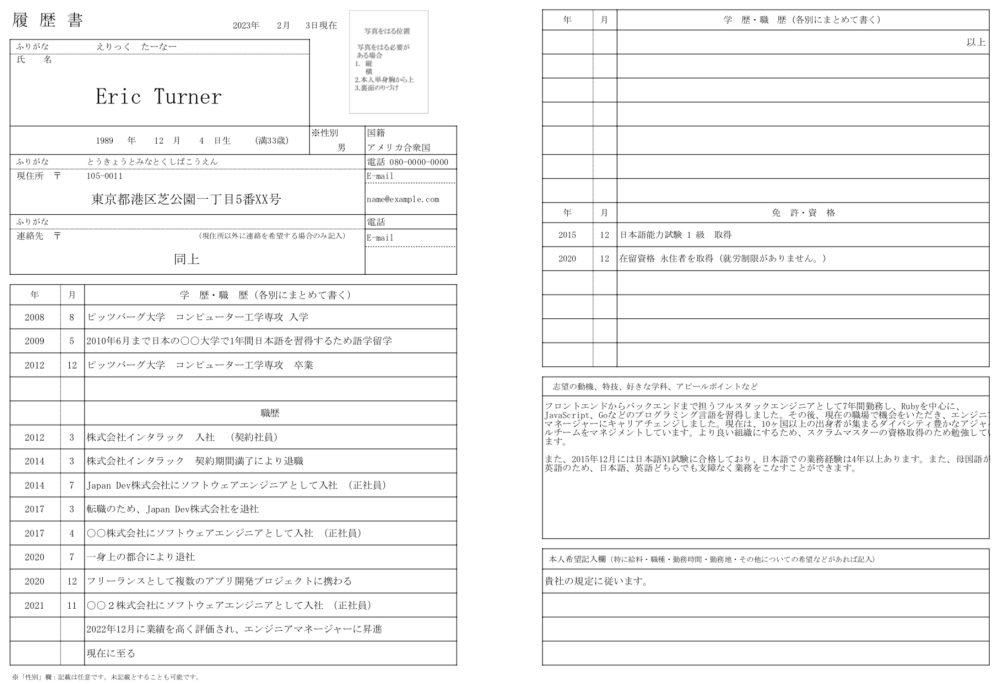
Let’s start by taking a closer look at the first section, which consists of your basic personal information.
1. Basic Personal Information
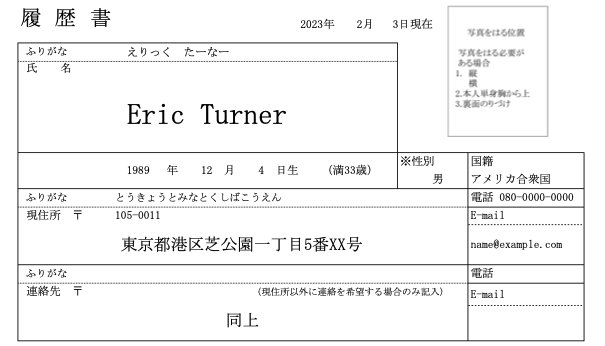
This first section of your resume will consist of:
Your photo,
Your date of birth and date of application,
Your address and phone number, and
Your contact information.
Resume Photo
Even though putting your photo on your resume is slowly becoming a relic of the past in the western world, the practice is still very much alive in Japan. Although this is less common in IT, it’s perfectly normal for most traditional companies to judge you by your resume photo in Japan.
Therefore, I recommend attaching a professional-looking photo where you look as presentable as possible. Make sure that your photo actually represents what you currently look like. Smiling without showing teeth is a good idea as well.
The photo should have a plain background, and being in proper business attire can’t hurt, either. Wearing hats, piercings, or accessories that are too “out there” are all big “no-nos” in a country like Japan.
Your hair should be tidy as well, and even though a well-kept and trimmed beard probably won’t be a problem if you’re applying to IT companies, I still recommend having no facial hair if you don’t want to risk it.
Generally speaking, following the same tips for interview attire in my post on what to wear to a job interview in Japan is a good idea if you’re ever unsure.
As for the formatting, your photo should be in the standard 3 cm x 4 cm format, and it should be no older than three months.
If you’re living in Japan, you’ll find photo booths pretty much everywhere around the business areas or train stations. You can have plenty of pictures taken in the correct format in these machines for about 600–800 JPY.
Your Date of Birth and Application Date
This one seems simple, but there are a couple of nuances.
First of all, ensure you’re consistent with the date format throughout your whole resume. If you’re writing your birthday in the U.S. format, fill out the application date accordingly as well.
Even though there isn’t a specific rule, if you’re applying to a traditional company, I recommend sticking with the Japanese date format, which is “year, month, day.” The day of the week or your age can also be added at the end in parentheses.
You can see this clearly in the example above — the birthday reads as 1989 年 12月 4日, and the current age is written in parentheses.
Lastly, the application date should match the date when you’re sending the application. If you’re bringing the resume to an interview, simply write the date of the day you’re bringing the application.
Your Address and Phone Number
When filling out your address, make sure that you don’t use abbreviations, as this is deemed unprofessional. If you’re already currently living in Japan, don’t forget to start the address with the name of the prefecture you live in as well.
As for phone numbers, including only your mobile number is fine. You don’t have to provide a landline, as most people don’t even have one anymore.
Your Contact Information
As strange as it may seem, this part is usually for your alternative contact information or address.
However, you can still fill in your email address and any other contact information you may have. Just don’t write your current work address or your address in your home country, as those will be irrelevant to the company you’re applying to.
2. Academic/Work History
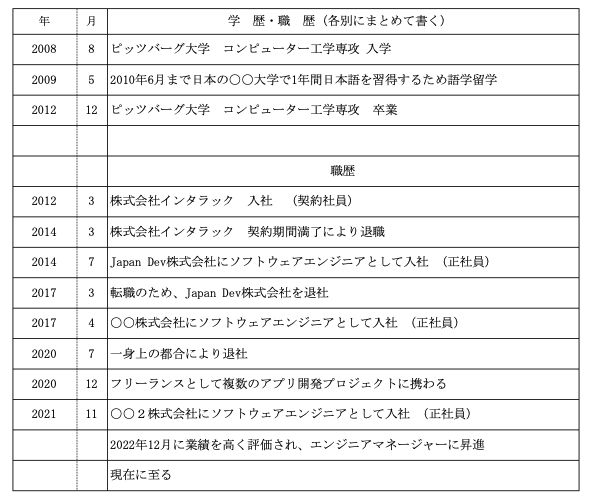
In a typical rirekisho, your academic background and your work history both go in the same section. This is because recruiters like to see everything in chronological order, which is how you’ll be preparing this section.
Academic History
For the education part, it’s generally recommended to write the last two institutions you graduated from. If you’re a college graduate, write your high school and your college. If you have a master’s degree, skip high school and only write your college and master’s programs. Essentially, you want to start from your education and work your way down to the present day.
However, there’s a slight nuance you need to watch out for. As opposed to a western-style resume, you’ll state the years you started and finished college on separate lines, as separate entries. For instance, there should be a line that reads “Entered X college/university,” and a separate line that shows your year of graduation as “Graduated from X college/university.”
Work History
As for your work background, you should mention any full-time positions (including contract-based ones if it was your main job during a time period). Usually internships or other part-time positions should be mentioned in the other, more fitting parts of your rirekisho, such as the self-promotion or reason for application sections. But do your best to fill the timeline so that there are no gaps. If you did have a period where you weren’t working full-time, it can be helpful to list volunteer work or similar.
When you’ve caught up to the present day and are finished with your work experiences, make sure to include a “現在に至る,” which means “up to present day” as well.
The correct way to end this section is by writing “以上,” which translates to something along the lines of “that’s all.” This may not make a lot of sense, but it’s a part of the format nonetheless. Speaking of format, don’t forget to make the last line aligned to the right, either.
Lastly, if you’re not sure whether you’ll also be submitting a shokumukeirekisho, which includes more detailed information, you can write the number of employees of the companies you worked for. You can also include a description of your position next to the names of each company.
Keep in mind, however, that a rirekisho normally doesn’t include such information. As I said, these details are usually found in the more detailed Japanese resume format, shokumukeirekisho, along with an explanation of how your experience relates to the job you’re applying for.
Therefore, if you’re also going to be sending a detailed resume, avoid repeating this information twice and simply leave these details out.
Please note, you normally don’t need a cover letter when applying primarily in Japanese with a rirekisho and shokumukeirekisho.
3. Licenses and Qualifications

This section is all about your relevant qualifications regarding the job, and you should include all certificates you may have in this section as well.
If you have a driver’s license, make sure to include it too. It’s somewhat relevant in Japan, as people get a driver’s license even if they don’t normally drive just because it looks good on their resume.
You also want to list any skills you have that are relevant to the position you’re applying for. Language certificates can work well here as well, even if they’re not Japanese-related. You never know when a foreign language will come in handy, so don’t forget to mention it.
4. Self-Promotion and Reason For Application
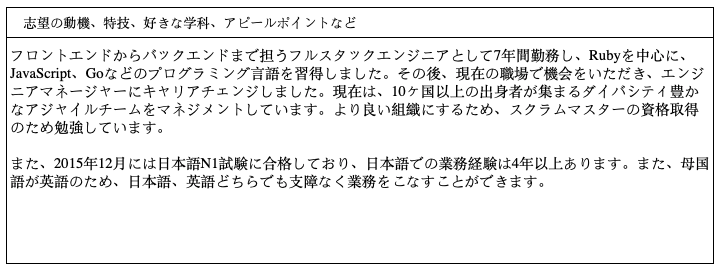
In the same field as the licenses and qualifications section, you’ll also have the opportunity to do some self-promotion and talk about your motivation for applying. Let’s talk about self-promotion first.
Promoting Yourself
Essentially, this is the part where you “sell” yourself. If you have any special skills that’ll help you get the job, this is the time to talk about it. Remember to keep it concise, though. You don’t want to overcrowd your resume with fluff, which might end up affecting your application negatively.
You also need to make a choice here. After all, you won’t be preparing separate, unique resumes for each and every job listing you’re applying to. Being too specific in this section might make your resume unusable for other jobs that are perhaps not your focus but might present opportunities.
Normally, people in Japan don’t tailor their rirekisho to the exact position, so it’s OK to be a little bit more generalized. You just want to make sure you give a good overview of your relevant skills.
For example, you can write something along the lines of, “I’d like to make use of my past experiences regarding insert your field of work here” (営業経験を活かして、 insert your field of work here の仕事にて活躍したい) in this part, which is a common phrase used in Japanese resumes.
As this is a serious document that you’ll be sending to companies, don’t forget to use the polite form of Japanese when you’re talking about yourself in this section.
Explaining Your Reason for Application
As I said, in this same section, you also get to state why you’re applying for the job. There might be some overlap with your Self-Promotion section though, so this isn’t strictly necessary. It can definitely help add some context for the specific type of position you’re applying to though.
Naturally, you want to be specific here. This is sort of a challenge because a rirekisho in nature is a short, brief “form” that you fill out, but you also want to leave an impression. This is why you want to think about your motivation thoroughly and decide on a few points that you can explain in a few short sentences.
If you have any special interests and hobbies that might have to do with the position you’re applying for, it’s a good idea to state these as your motivation. This will feel genuine and might set you apart from the other applicants.
However, try not to sound too vague or pretentious for the sake of filling out this field. You’ll just want to come off as insincere and might even end up lowering your chances of getting the job. If you’re unsure, simply follow the same advice I gave for self-promotion and state that your past experience in the field is why you’re applying.
Again, don’t forget to use the polite Japanese form when you’re stating your reasons here, just like in the self-promotion section.
5. Personal Requests
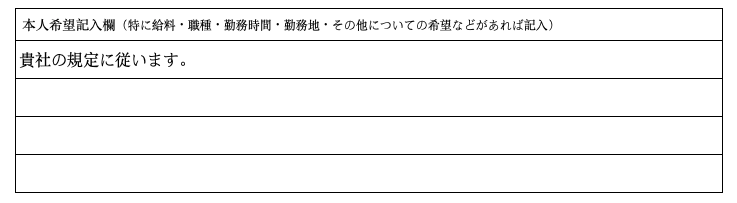
In this final section of your rirekisho, you have the opportunity to talk about any requests you may have for accommodating your special condition(s), as well as your hopes and expectations regarding the job.
Since there’s likely going to be an interview following your application, you can also choose to talk about your requests during the interview. If that’s the case, leaving this part empty is perfectly fine.
If you don’t want to leave it empty, just write something like, “I’ll comply with company regulations.” (貴社の規定に従います), which is what most people write anyway. Alternatively, something along the lines of, “I’d like to consult/discuss the conditions with you.” (ご相談させて頂きたいと思っております.) can be an acceptable answer as well.
This doesn’t mean that you shouldn’t write anything sincere in this field, of course. It’s not uncommon to write actual requests in this part, as some people even state their expectations regarding the salary here.
You can also use this field to mention your available times for the interview.
Japanese Resume Template Download
Here you’ll find a downloadable Japanese resume example that I have prepared. The screenshots I’ve included above are from that template.
This is the template recommended by the Japanese Ministry of Health, Labor, and Welfare, but I modified it so that it’s more suitable for foreigners. I also updated a few sections, which I’ll explain below.
The Best (And Up-To-Date) Japanese Resume Sample
If you look up other rirekisho templates online, you’ll realize that most of them include sections that are not included in the resume template we shared. This is because a few changes were made to the standard resume format in 2020.
According to these new changes, sections such as “commute time,” “number of dependents,” “spouse,” and “spousal support obligation” have been omitted from the template, all of which you can still see on most other templates online.
Additionally, the gender field is now made optional, so you can leave it blank if you don’t feel comfortable sharing such information.
We’ve also added a nationality field for foreigners, which can be left blank since it’s not in the original template.
Here’s a downloadable Google Spreadsheet link to the template. You can also download a template I prepared for the second, more detailed type of resume that’s in use in Japan, which is shokumukeirekisho.
Do Japanese Resumes Need to Be Handwritten?
If you looked up how to write resumes for job applications in Japan, you might have stumbled upon the myth of handwritten resumes.
While calling handwritten resumes “a myth” is a bit of an exaggeration, nowadays, you really don’t need to worry about writing your resume by hand in Japan.
It’s true that a handwritten resume was almost a requirement in the past. It was a way to show your enthusiasm to your potential employer, and it was also seen as a sign of respect. Some companies even deemed it outright disrespectful to present a resume with errors, or worse, a resume with corrections on it.
Luckily, in the digital age, this isn’t the case anymore. You can now simply create your resume as a digital document and send as many copies as you’d like to however many job listings you’re applying for.
Conclusion
If you don’t know where to start, preparing a resume can be tough, but hopefully, this post helped clear up everything for you.
Before I go, here’s my final advice on writing your resume. As a foreigner, no matter how much you trust your Japanese skills, it’s always a good idea to run your final rirekisho by a native Japanese speaker if you have the chance.
After all, this is an important document that’ll help you make the first impression at a company. This way, you can avoid unnecessary mistakes, and if it turns out that your resume is error-free, you get to brag about your awesome Japanese skills, so you win either way.
Lastly, if you have any questions about the job hunt in Japan, you can head on over to my post, where I talk about the process of job hunting in Japan in detail. Also, you might find my guide on finding a job in Japan as a software engineer useful as well.


Japan Dev Editorial Team
This post was written by the Japan Dev editorial team, based on Japanese official sources.
- Senior Full-Stack Software Engineer
- Visual Alpha
- Tokyo
- ¥6M ~ ¥10M
- AI Systems Engineer
- Rapyuta Robotics
- Tokyo
- Embedded Software Engineer - Robotics
- Rapyuta Robotics
- Tokyo
- Quality Assurance Architect - Robotics & Automation
- Rapyuta Robotics
- Tokyo
- IT Security & Compliance Lead
- Rapyuta Robotics
- Tokyo


Latest Tech Jobs 🇯🇵
Explore the top developer jobs in Japan for foreigners
- Senior Full-Stack Software Engineer
- Visual Alpha
- Tokyo
- ¥6M ~ ¥10M
- AI Systems Engineer
- Rapyuta Robotics
- Tokyo
- Embedded Software Engineer - Robotics
- Rapyuta Robotics
- Tokyo
- Quality Assurance Architect - Robotics & Automation
- Rapyuta Robotics
- Tokyo
- IT Security & Compliance Lead
- Rapyuta Robotics
- Tokyo
- Client-Facing Solution Architect
- Visual Alpha
- Tokyo
- ¥8M ~ ¥12M
- Full Stack Engineer
- Omakase.ai
- Tokyo
- Backend Developer
- Jamm
- Tokyo
- ¥7M ~ ¥10M
- Full Stack Developer
- Jamm
- Tokyo
- ¥7M ~ ¥10M
- QA Engineer (ExaEnterpriseAI - 生成AI事業)
- ExaWizards
- Tokyo
- ¥6M ~ ¥9M



Get Job Alerts
Sign up for our newsletter to get hand-picked tech jobs in Japan – straight to your inbox.

© 2026 Japan Dev. All rights reserved.
Proudly built in Tokyo.


Curated with 💙 in Tokyo by Eric Turner
All our data is gathered from publicly available sources or contributed by users