



Updated January 21, 2026
Train Etiquette in Japan: A Culture Peek Into What Keeps it Running
(right image) English Translation: "Please observe 'Mobile Phone Manners.'"
Nothing captures the essence of what life in modern Japan feels quite like the rail system here. The efficiency of the train systems in Japan is not just a reflection of the companies that run them like clockwork, but also of the people that generally adhere to the cultural norms of their use.These trains seamlessly serve millions of passengers on a daily basis all across the country. In fact, if you rank the busiest train stations all throughout the world, most of the top 50 are in Japan.
#1 Mind your manners
Before we dive into the rules of the rail, let’s talk about manners. The idea of manners permeates the culture and is often found in everyday life. The word is used broadly to describe good behaviors, but mostly in a way to prevent annoying behaviors. For example, a poster requesting residents to be mindful of making noise at night might be reasonable to find. But in a more hidden place you can find a request for following “manners of phone use” at the bottom of an iphone advertisement.
In Japan, anything that is seen to cause a disturbance to anyone else is broadly described as lacking in manners. That is important because often manners are cited as the reason for new rules. Manners are held with such high regard, and this is especially true when using the train system. It might seem a little bit overwhelming, so let’s break down some etiquette rules.
#2 Manner Mode: Silence and Space
Sound/Noise:
My phone never rings. I don’t even use the alarm function anymore since I rely on my watch to alert me to vibrate my wrist when I need it. Manner-mode is the default setting. What is manner mode? It’s essentially turning off any noise from a phone; either muted or on vibrate only.
The fact that it is called manner-mode is very Japanese to me as well. Basically creating noise is rude.
Most people will prefer to use text-based communication over calling. If they get a call whilst on the train, they can pick up the phone and briefly tell the caller that they will call back after getting off. Usually this will be done with a quiet neutral tone voice and a general haste in the body language, which might look like they are bowing a bit into the air. They are showing the other people on the train that it is not the intention to be disruptive and everything is being done to minimize disruption. On the platform before getting onto the train car, taking calls is okay. The platform is not an enclosed space, so it is easy to go off to some private spot where voices feel less disruptive. But it is always a good idea to mind the surroundings as they can change dynamically.
What about the Shinkansen?:
Shinkansen are a great way to get between large cities in Japan. But the long distance usually means every now and again a phone call will likely happen. The accepted practice is to move to the section between cars (usually where the bathrooms are) and conduct the call there. This might also apply to some special express trains that cost extra to board so pay attention to the surroundings.
Space:
Manners don’t end with the noise; attention to space is a part of the deal. This is especially true in enclosed spaces like trains or elevators.
Before entering the train it is a good idea to swing your backpack to your belly-side to give you more control of it when maneuvering around. Suitcases are a bit tricky but I try to tuck them into the space between the door and seats to avoid the traffic.
If you manage to grab a seat, it is standard to have your bags in the compartment above or more commonly placed neatly on your lap. Try to be as compact as comfort allows. What if there are very few people and plenty of space? In this case it is okay to keep your backpack on your back or even use the seat beside you to place your bags. Just be aware of the situation as it can change in a moment and be ready to move. On that note of awareness, priority seats are generally located on each end of each train car and the idea is that anyone can sit in them and will give up their seat to someone in need of it. For a country of rules and unspoken costumes, it is ironic that the priority seating rule is not so enforced as it could be.
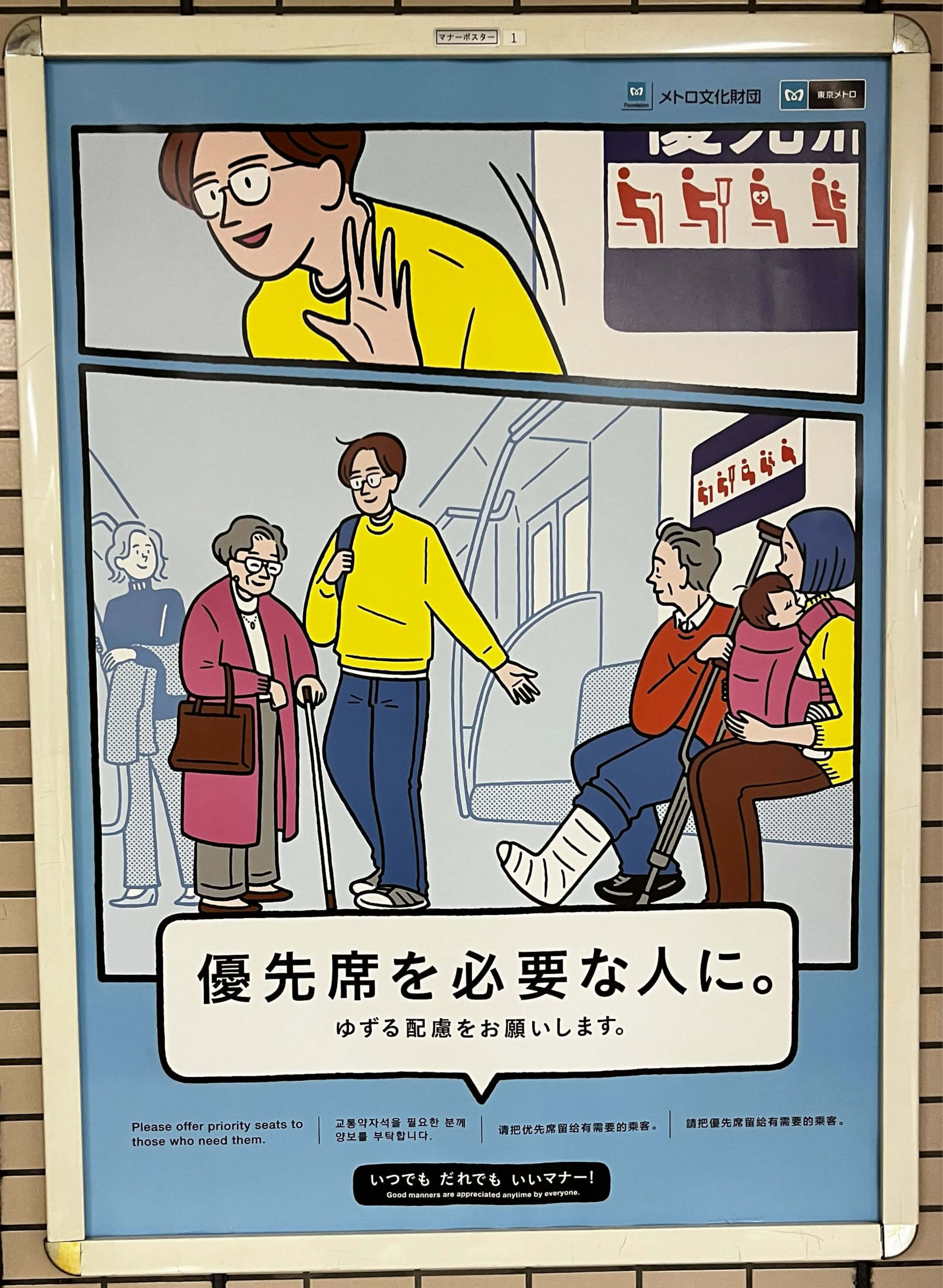
English Translation: "We ask for the consideration to offer priority seats to those who need it."
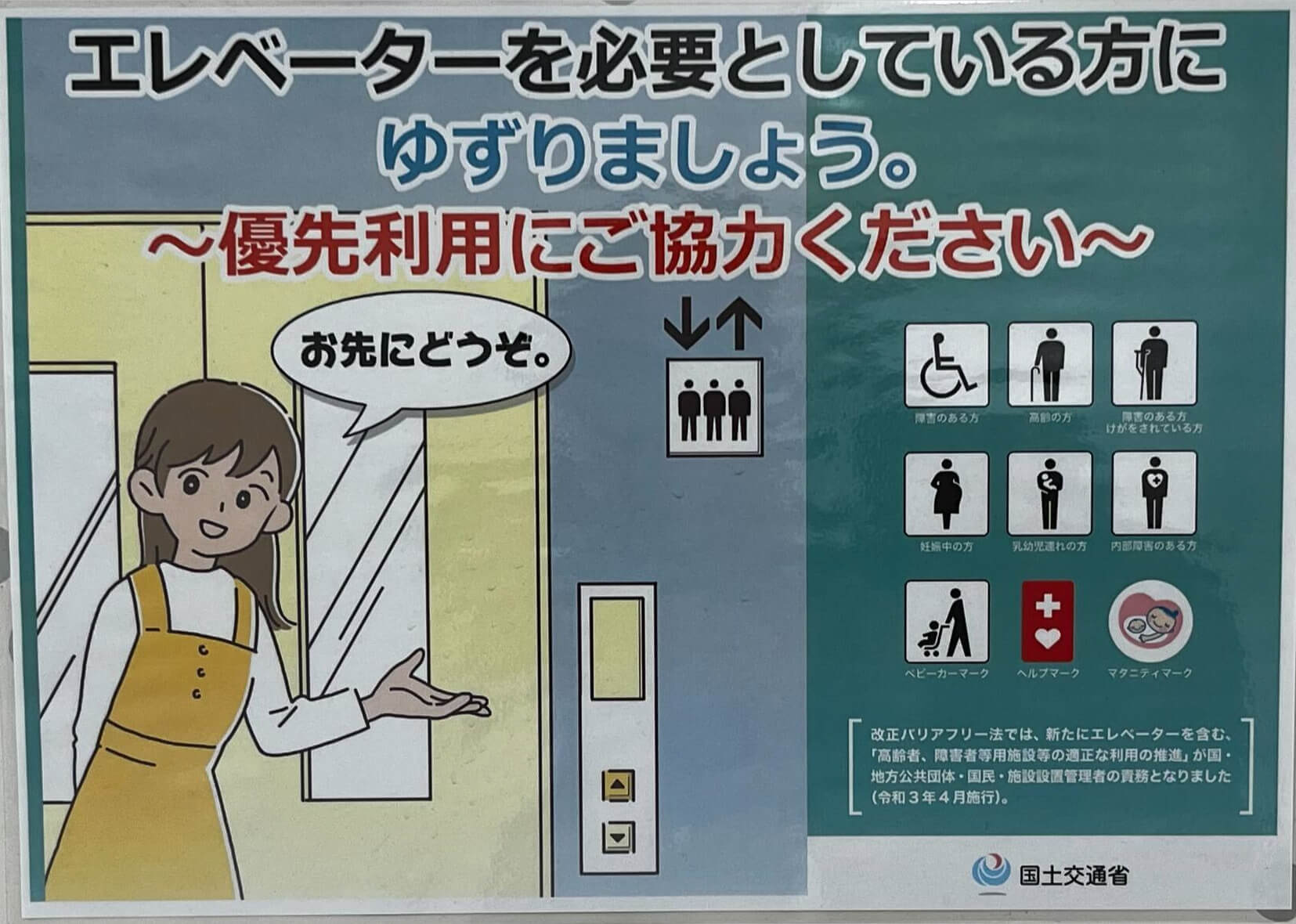
English Translation: "Let's give way to those who need the elevator."
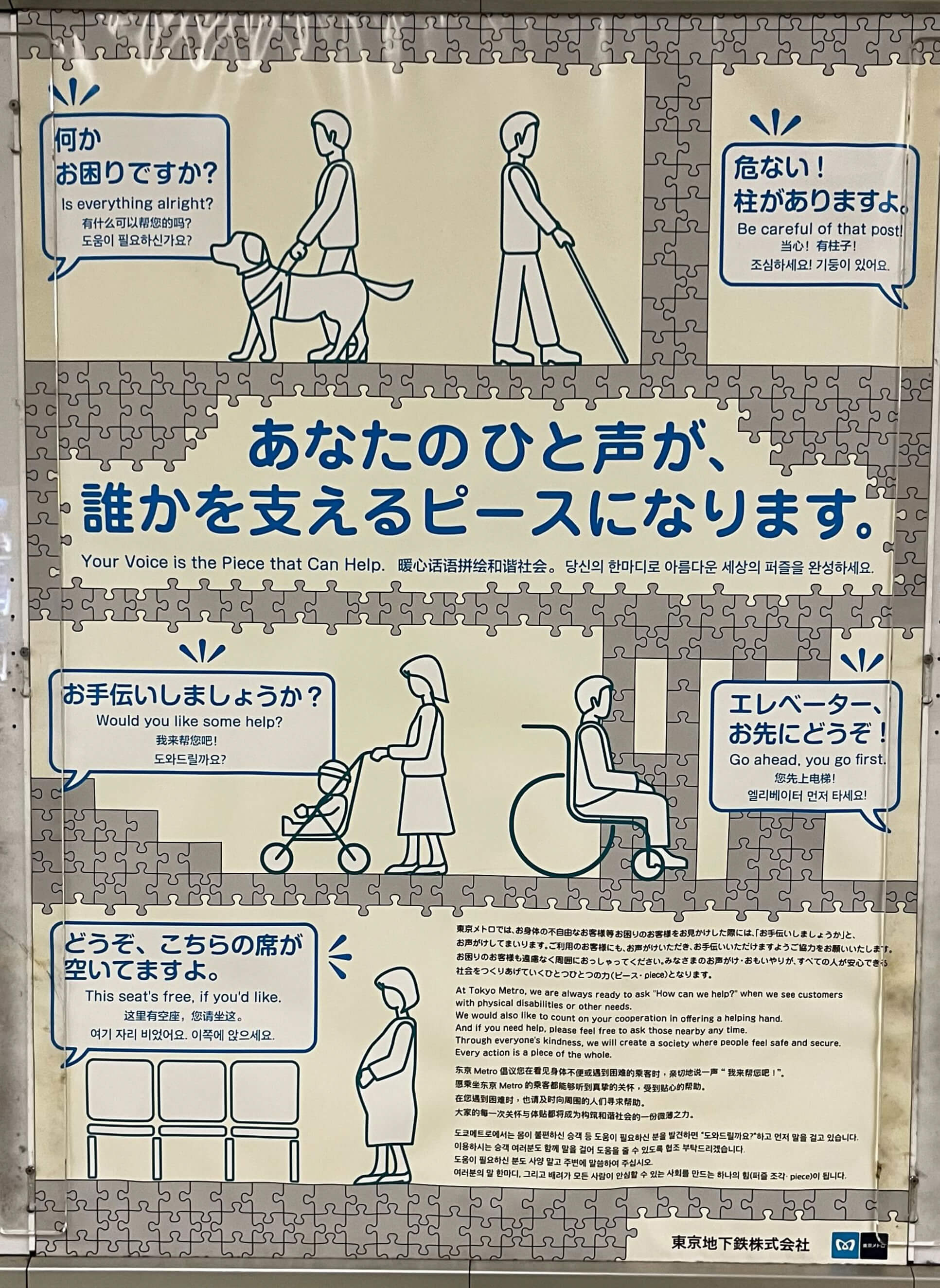
English Translation: "A single voice can be a piece of support for someone."
If you see someone who could use your seat, just get up. People will often refuse out of politeness when offered a seat, but if you just move away quietly they will accept the open seat.
This ritual might seem a little strange, but it is a face-saving move because the person you open up a seat for does not have to feel the burden of publicly being helped. Silent gestures are more appreciated than open and obvious help.
Garbage:
It is widely accepted that personal garbage is to be taken home. It should not be surprising that there are very few garbage cans inside train stations and virtually none on platforms of local trains. Nevertheless the trains remain clean because most riders cooperate with this norm. More on garbage related information in this article.
Maternity badges:
If you see a mark like this hanging off of a bag or an article of clothing, it means the bearer is pregnant. You can avoid an awkward conversation and simply skip straight to making way in a priority seat.

Eye-contact: Even if you keep your distance, prolonged direct eye-contact can be interpreted as judgemental, confrontational, or otherwise a violation of personal space.
Adjustable Seats: Be aware of people behind before lowering the seat back on shinkansen or special express trains. Do it slowly and gracefully. “Nagara-sumaho”: “Nagara-sumaho” or doing something while operating a smartphone. Clearly if you are driving while (or nagara) using a smartphone, it could be a dangerous combination. And while it might be frowned upon we all walk and use our phones.
Still, you may hear that it is manner-infringement to nagara-sumaho on the platform. The key here as I have repeated several times is awareness. As long as you spare some of that awareness to the people and objects around you, it isn’t a sin to use your phone and walk.
Walking up or down the escalator: Recently, there has been a movement to change the culture to stop this with the posters around the station. In all honesty, I don’t see Tokyo or Osaka changing anytime soon.
In 2025 Nagoya had taken more direct action and hired people to physically block people from walking. Nagoya city is clearly a little more serious in making this manner “its thing.”
The comments on this Reddit thread reflect the general attitudes towards the movement. I tend to agree that maintenance costs of people walking up and down escalators are most likely the reason for this movement, and safety manners are only the facade.
We might start to see growing regional differences of what acceptable manners are and are not in the coming years.
Running to catching the train is dangerous: Most platforms now have these special barriers to prevent runners from jumping into the trains as the doors are closing. That doesn’t stop everyone from attempting to catch a train that is about to take off. When it does happen, you can expect the train conductor to make a stern announcement to publicly shame that person.
#3 Slow is Smooth. Smooth is Fast
From the train ticket booth and gates, to the train platform and carriages themselves; there are so many chokepoints that could easily cause delays. But one of the reasons these bottlenecks don’t create the delays you see in other countries where delays might be expected is because of the general understanding among the commuters themselves. That is to say the commuters are smooth.
Let me paint a picture: Imagine you are on the platform waiting for the next train to arrive. Conveniently the platform is marked clearly where the doors will be and so you line up in the vicinity of the expected door. The train arrives exactly on time exactly where it was supposed to. As it rolls in you can see there are a few people already on the opposite side of that door clearly about to get off.
Naturally you just move to the side and let those people get off. As it happens, there are a lot more people getting off and you move even further back to make room, some people have gotten off but aren’t headed for the exit, no they are getting back on the train they just got off of. But they are not rushing back in, patiently waiting for more room to be available inside and now everyone on the platform can flow in quicker than if there is one human-traffic-cone blocking the way. By being patient and waiting for the crowd to subside, the flow is much smoother and the train is already on its way to the next stop on schedule.
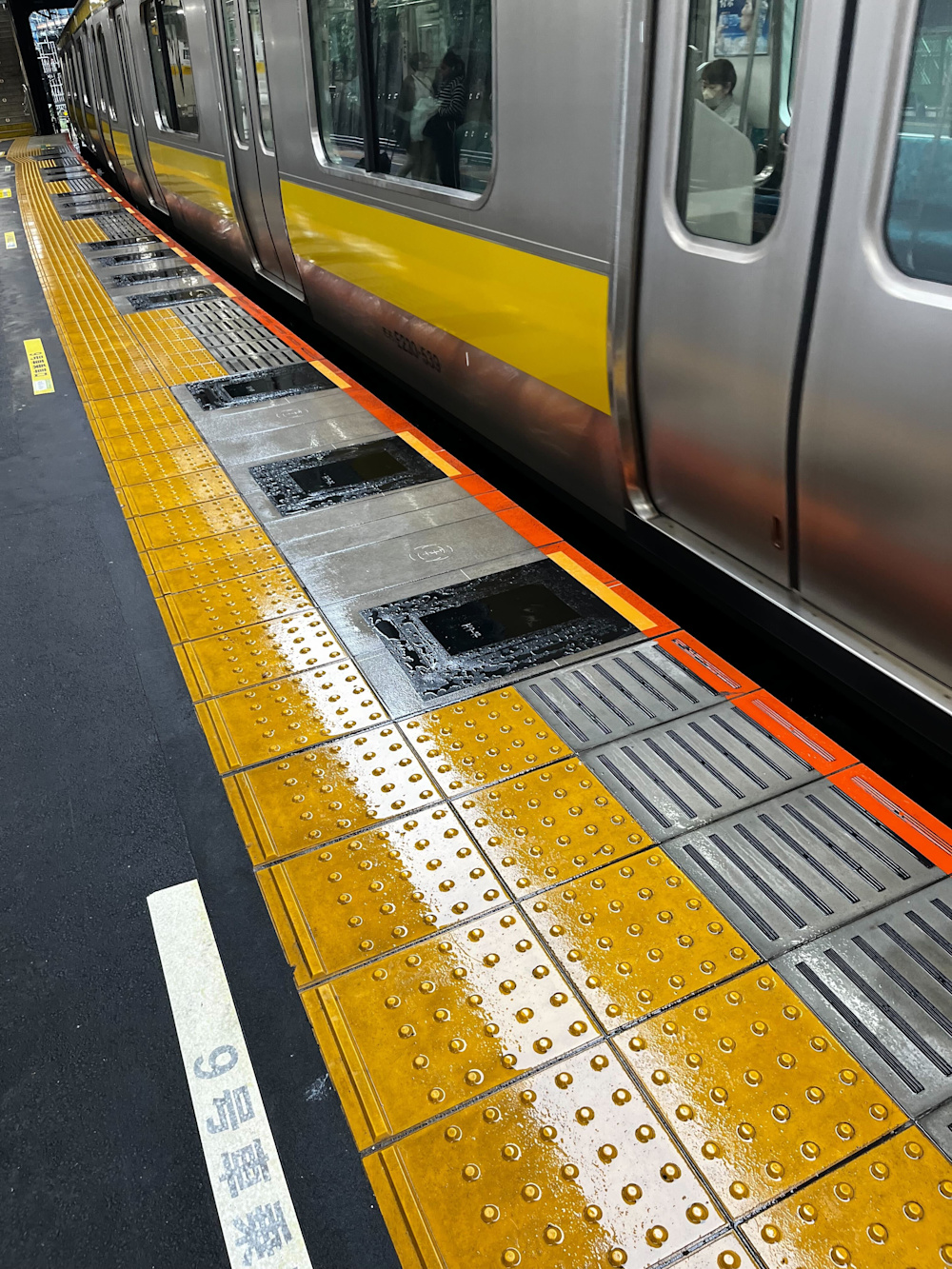
Take that scenario and imagine it is happening every second at nearly every major station. Japanese commuters have come to expect this as the norm and If you are being a traffic cone, you could be pushed aside unintentionally or in some instances quite intentionally; it is passive-aggressive but not uncommon.
The lesson is to keep in mind that others will be using public transportation and most of those people are not going in the same direction as you. These other people in your perspective might be obstacles, but to them you are the obstacle. Public transportation is a mutually assured obstacle course. The best we can do is acknowledge and help each other out.
As I wrote that on my laptop on the Shinkansen, I had popped up quickly from my aisle seat to let the gentleman on the window seat get off without any eye-contact nor words exchanged. Just a shared experience of each other's inconveniences, that we would like to quickly move on from.
#4 One“sumimasen” is all it takes
When in doubt, always say “sumimasen.” It means “excuse me” and is quite a useful phrase because it is simple yet can convey your awareness. Sumimasen is both fast and polite.
Here are some situations you can say sumimasen.
Sitting next to a person and their things are in the way
Making room for someone else to sit or stand
When bumping into others, or getting bumped into
Walking on the escalator and looking to get through (excepting Nagoya)
Getting off the train and you need others to move
Thanking someone for holding the elevator door for you
This phrase is useful for other situations too. So it is good to just say it all the time. If you are living in Japan, saying it should almost be a reflex.
#5 The need for feed
Eating in public is generally not accepted behavior. This is especially true inside the train. Some kiosks will sell some snacks, but try to save those for later.
Even if you are not eating food on the train, bringing aromatic foods into the train can be risky too. Stinky foods attract nasty glances. Try to keep them off the train, or at least cover it up well in a few layers of bags.
For drinks, it is also best to wait until getting off the train if it can wait. But sometimes you just have to have a sip, so it is okay to bring a bottled drink in and have a few sips quickly especially if it’s a hot summer day, but be careful not to spill anything, no one likes a sticky floor.
For the most part, there is no rule against public drinking, and sometimes you will see someone holding a can of alcohol. Most will turn a blind but judgy eye.
I can see that changing in the future if too many instances of “bad-mannered” individuals create the reason for new enforced rules on the trains. This happened famously in the streets of Shibuya on Halloween, where too many rowdy folks led lawmakers to ban public drinking in the area.
#6 Avoiding sexual harassment
Public transportation is meant to be shared and a pleasant experience for as many of the riders as possible. During the morning rush hours, that could mean the trains get crowded and personal space is not an option.
Crowded trains are notorious for harboring molesters. That’s why many trains have women-only cars for designated hours (different for each train line).
That doesn’t prevent all cases of sexual harassment so it is important to be vigilant. For men it’s important to clearly have your hands visible to avoid being accused of molestation. The easy way to always be in the clear is to hold the hand-rails as high up as comfortable.
For men to avoid being mistakenly accused of molesting someone, it is best to keep both hands in plain sight, as by holding on to straps. Men also need to take precautions against being falsely accused of molesting others.
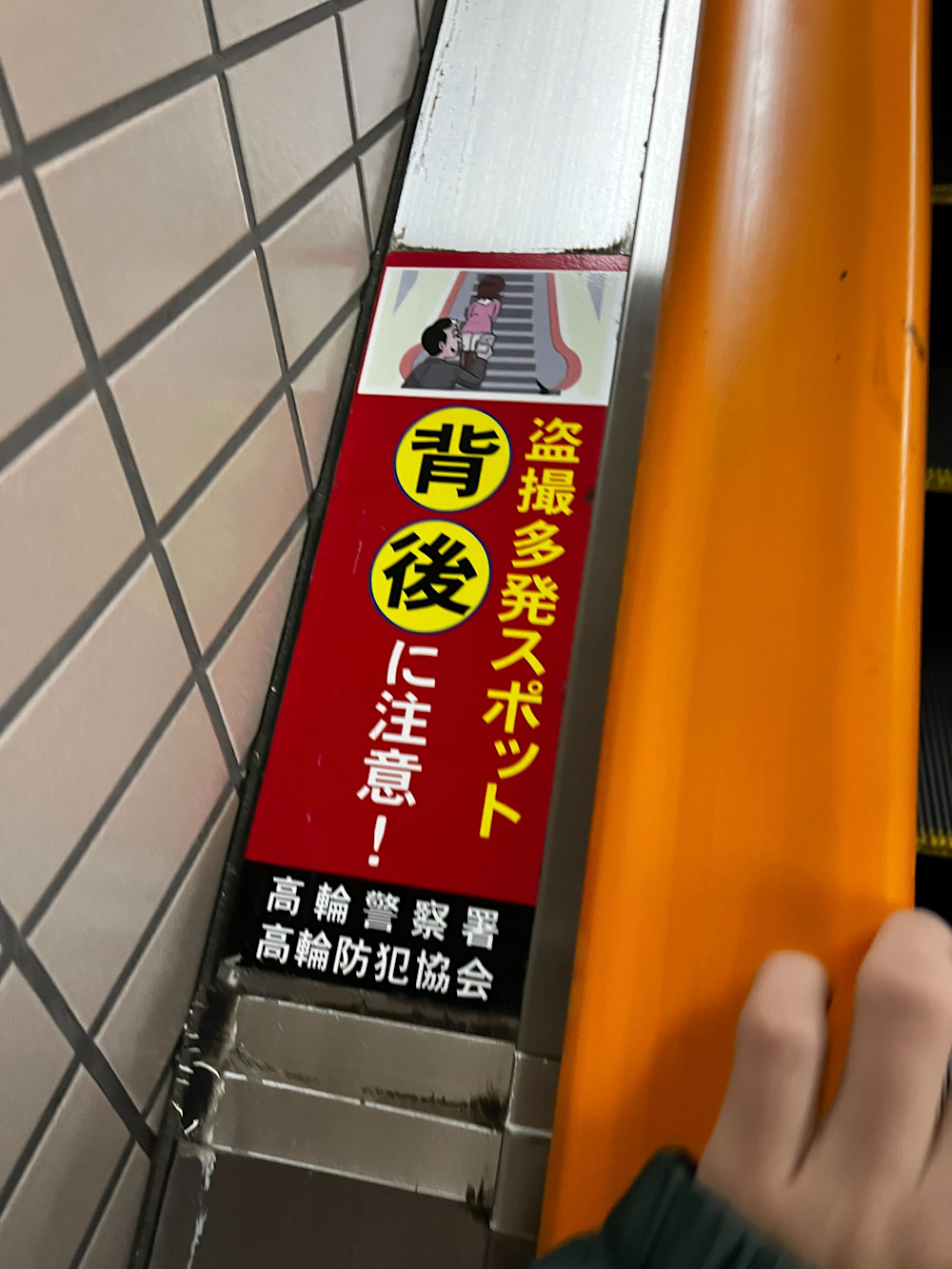
Another common problem is “tou-satu” (盗撮) or stolen photography. Tou-satsu is the act of taking a photograph or recording of someone without permission. In more nefarious cases, it could mean snapping upskirt photographs.
Tou-satsu prevention is one of the reasons Japanese phone cameras make a shutter sound. Be aware of escalators for suspicious folks, and don’t be mistaken as a suspicious person either.
#7 In summary
There are so many rules it seems and so difficult to remember all of them. They are what gives Japan its reputation for hospitality, cleanliness, and bureaucracy.
Think of the many rules of etiquette as more like guidelines. The first step is having awareness of yourself and surroundings. From there you will start to notice more and more about how things work and be able to adapt naturally.
For trains, that awareness should be dialed up because space is more confined and noise is more noticeable. But as long as you want to respect that public transportation is a shared space, it takes everyone's mutual understanding to keep it as nice as it is.

Rei Yabe Duruz
Rei is a Japanese/American digital producer, working on mostly website development projects. He came to Japan from New York as a university student and has never turned back since. With 15+ years of experience living in Tokyo, his successes and failures navigating the working culture of Japan has given him a unique perspective on how to better manage the quirks of making a living in Japan.
- SRE - DataOps/MLOps
- Autify
- Tokyo
- ¥8.5M ~ ¥10M
- Software Engineer
- Solafune
- Tokyo
- ¥7M ~ ¥10M
- Senior Software Engineer
- Solafune
- Tokyo
- ¥10M ~ ¥13M
- Cybersecurity Document Creation Support
- Solafune
- Tokyo
- ¥5M ~ ¥7.5M
- Security Verification Engineer (Cyber Defense - Gov't Project)
- Solafune
- Tokyo
- Up to ¥8.5M


Latest Tech Jobs 🇯🇵
Explore the top developer jobs in Japan for foreigners
- SRE - DataOps/MLOps
- Autify
- Tokyo
- ¥8.5M ~ ¥10M
- Software Engineer
- Solafune
- Tokyo
- ¥7M ~ ¥10M
- Senior Software Engineer
- Solafune
- Tokyo
- ¥10M ~ ¥13M
- Cybersecurity Document Creation Support
- Solafune
- Tokyo
- ¥5M ~ ¥7.5M
- Security Verification Engineer (Cyber Defense - Gov't Project)
- Solafune
- Tokyo
- Up to ¥8.5M
- Engineering Manager, Money Forward Cloud, Fukuoka
- Money Forward
- Fukuoka
- ¥10M ~ ¥15M
- SRE and Platform Engineering Lead, Platform Department 2, Tokyo
- Money Forward
- Tokyo
- ¥7.9M ~ ¥15M
- AI Tech Lead (Context & Harness), CTO Office
- Money Forward
- Tokyo
- ¥7.9M ~ ¥15M
- Backend Engineer / バックエンドエンジニア (LINEミニアプリ)
- LY Corporation
- Tokyo
- ¥8M ~ ¥15M



Get Job Alerts
Sign up for our newsletter to get hand-picked tech jobs in Japan – straight to your inbox.

© 2026 Japan Dev. All rights reserved.
Proudly built in Tokyo.


Curated with 💙 in Tokyo
All our data is gathered from publicly available sources or contributed by users