



Updated October 24, 2024
All about Japan's Family Registry (Koseki Tohon and Shohon)


Japan Dev Editorial Team
日本在住の編集チームが、日本のテック業界と暮らしに関するガイドや記事をお届けします。記事は日本の政府機関の情報をもとに調査し、編集基準はJapan Dev共同創業者のManami Turnerが監修しています。
The “Koseki (戸籍)” is an important part of Japan’s citizenship and family registry law.
This document, which translates to “family registry,” differs from other official documents like the “Juminhyo” in that it concerns one’s whole family line.
Of course, only Japanese naturals get to have a Koseki record, but there are some exceptions where foreigners can also join the registry.
So, read on to find out who can be included in the Japanese Family Registry (Koseki) system, its significance and use cases, why it may interest you as a foreign Japanese descendant, and other relevant details.
In this article: 📝
What Is Koseki Family Registry Records?
In Japan, the Koseki system is where all of your family and personal data are stored.
Koseki essentially keeps a record of all Japanese households. While it’s only for Japanese citizens, some exceptions may include foreigners, like if you marry a Japanese person or are a direct descendant of a Japanese citizen.
Koseki records (Koseki tohon) are most commonly updated when significant life events occur, more specifically:
Birth
Coming of age
Marriage
Death
When a child comes of age, they’re separated from the family registry and are recorded under a new one. Similarly, when one gets married, both the couple’s and their families’ registries get updated accordingly.
Other than these cases, Koseki can also be updated for corrective purposes, which is a rarer occurrence.
The registry serves as a way to verify citizenship, but it doesn’t serve as official proof of one’s personal details. This is because the information presented on the Koseki records is strictly based on the citizens’ statements.
Why Japanese Family Registry Records Are Kept: The Use Cases of Koseki
As I explained, the family registry records store family lineage data, which is one of the reasons why these records are kept.
Other than this, the family registry also serves as proof of one’s citizenship here in Japan.
The Koseki records also help verify someone’s identity. The records are kept for 150 years by law, allowing individuals to track their lineage over several generations.
When Do You Need a Koseki Copy Issued?
While it’s not a must-keep-in-your-wallet type of document, there are many occasions where a copy of your Koseki records is required.
Procedures related to death, such as when creating a will or when handling inheritance procedures
Making a life insurance claim
Renewing your passport or when applying for the first time
Applying for your pension benefits
Adoption procedures
Getting married outside of your registered domicile
Getting a divorce, regardless of where your domicile is
When a change is being made to the records on request, such as changing one’s legal name
Can Foreigners Get a Koseki?
As I mentioned, only Japanese citizens’ records are kept in the Koseki register, but there are some exceptions for foreigners.
Getting Married
A foreigner who’s yet to be naturalized into a Japanese citizen can enter into the Koseki registry via marriage. This is actually an exception as the spouse only “technically” gets a koseki.
If a foreigner marries a Japanese citizen, their name also gets recorded, but under their spouse’s Koseki. Until they officially become citizens themselves, foreigners don’t get to have their own Koseki registry and can only appear in another person’s record.
Naturalization and Becoming a Japanese Citizen
Another way of getting a Koseki as a foreigner is to actually cease being one.
Considering you fulfill the requirements, you can become a Japanese citizen through Japan’s naturalization process. Upon successfully gaining citizenship title in Japan, a Koseki record under your name will have to be created even if you aren’t married to a Japanese person.
If you’re registered into the Koseki system this way, you won’t have to show proof of familial relationship when applying for a copy of your Koseki records.
Being a Direct Japanese Descendant
The Family Register Act allows foreigners to apply for Koseki records if they suspect they may be direct descendants of a Japanese citizen.
So, what documents do you need to prove kinship in Japan? Well, it depends on the case, but any official document that proves that you’re a direct descendant of the person in question should work according to the law.
As long as you’re a direct descendant of a Japanese citizen, you are legally allowed to obtain a copy and use it for your citizenship procedures.
Foreigners and The Family Register Act Japan
We’ve established that foreigners aren’t registered in the Koseki system unless they marry a Japanese person and enter that person’s registry. That said, the Family Register Act still requires foreigners to notify the city office when the following events occur:
Death: A “Notification of Death (死亡届 = shibou todoke)” must be filled
Birth: A “Notification of Child's Birth (出産届 = shussan todoke)” must be filled
Marriage: A “Marriage Notification (婚姻届 = kekkon todoke)” must be filled
The city office needs to be notified of these events as long as they occur within Japan, regardless of the nationality of those attached.
Who Can Request a Koseki At The City Office
You can only request the Koseki records of your own direct lineage, which means you can’t get the records of your indirect relatives.
The general rule is that all individuals who are recorded in the family register as parents, spouses, or other immediate relatives can request a copy of their Koseki records.
The abovementioned rule also applies to foreigners included in the family registry.
In addition to the above, legally assigned representatives, such as lawyers, are also able to request Koseki copies of the client’s Koseki records. It goes without mentioning that the courts can also order one’s Koseki records but this is very rare.
However, do keep in mind that some city offices may not allow representatives other than lawyers to have Koseki records issued. This usually depends on the urgency and direness of each specific case.
What’s Included in Japanese Family History Records
Koseki tohon records contain the most basic personal information of each family member. These are:
Names
Dates of birth
Registered domiciles
Marital statuses
Birth parents and their relationships to each individual
Children’s names of each individual
In a way, the Joseki kohon includes all of the information needed to map out a good chunk of the family tree at any given period in time. The records are kept for 150 years, so they offer extensive family history.
Once someone marries or becomes independent of their family, their records are erased from the previous family register, and a new one is created for the new family.
In addition to the above, some older Koseki records may also have social status of each person included as well, but this is an outdated idea that Japan as a government no longer subscribes to.
The Difference Between Koseki Tohon and Koseki Shohon
Two documents have “Koseki” in their names: “koseki tohon (戸籍謄本)” and “koseki shohon (戸籍抄本)”.
So far, whenever we referred to the Japanese family registry records, we were talking about Koseki tohon, which includes the records of all family members you’re immediately related to.
Koseki shohon, on the other hand, is much more brief in nature, as it only involves the records of a single family member.
In many cases, you may only be required to present the information of a specific family member, such as your parents. When this happens, you can provide only that part of your full Koseki tohon, called a “koseki shohon.”
This explains why some municipalities call the full koseki tohon “Zenbu Jiko Shomei Sho (全部事項証明書)” which means “Certificate of all records.”
While most municipalities don’t use this name anymore, some sources may refer to the document with this name, so it’s good to keep it in mind.
Family Registry Japan: How Is It Different Than The Juminhyo?
As you know by now, the family registry, or the Koseki, is the system that records all family members and is used to prove one’s identity.
On the other hand, Juminhyo is the resident’s record. In addition to personal information, like a person’s name, address, date of birth, and so on, it includes more practical information about a person. This can be information related to pension and healthcare eligibility, as well as the person’s vaccination status.
Not only does this mean that all residents of Japan, including foreigners, are included here, but it also means that it doesn’t involve one’s kinship status and familial relationships.
So, the main difference between the Juminhyo and the Koseki can be summed up as the latter being a family record while the former is about the records of the individual.
How to File For A Copy of Koseki Kohon: Step-By-Step
If you need a copy of your Koseki tohon issued, you have two options: go to the city office yourself or send a mail-in application instead.
There’s also a third, exceptional way where someone else can apply on your behalf, but first, let’s explain the application process at the city office.
Obtaining Koseki Family Registry Records at The City Office
You can only obtain your Koseki tohon copy at the city office in your registered domicile.
Here’s what you need to prepare.
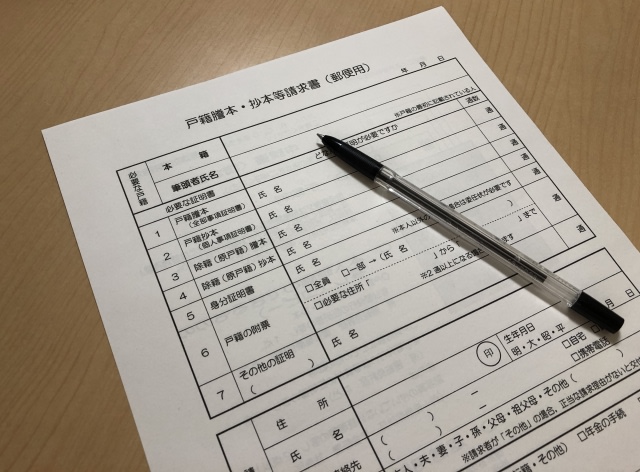
What Documents Do I Need For The Koseki Tohon
Koseki Tohon is obtained by filling out an application form. Depending on your specific case and who's submitting the application, you need to attach a varying number of additional documents.
The application form in question is called the “Shinsen Sho (申請書)”, and you may find it at your city office or online, depending on your municipality. Simply look up the words “戸籍謄本” with the name of your city, and you’ll find it.
In addition to the application form, you need an identification document, like your driver’s license, passport, national health insurance card, or your My Number Card.
What’s more, depending on your case, you might need additional documents. For instance, if you’re asking for another person’s information in your Koseki records, you’ll need to show proof of your relationship with them.
The same goes for foreign spouses who want to get their husband’s Koseki tohon. In this case, a marriage certificate will be required as proof.
Submitting Your Documents At The City Office
When your documents are ready, all you need to do is head over to your local city office to hand in your application. You don’t have to set aside too much time as it doesn’t take long and you receive the copy right away.
Remember that if your municipality doesn’t offer the application form online, you’ll have to fill one out at the city office.
Upon submitting your application, you’ll be issued with a copy of your Koseki tohon or shohon, depending on your request. Keep in mind that a fee is also due upon application, which should be somewhere between 350 to 450 JPY.
Option 2: The Mail-In Koseki Tohon Application
Mailing in your application for a copy of your Koseki tohon is also possible, however, this is a much less common way to do it. Plus, it certainly isn’t quick by any means, so it’s not recommended if you’re under any sort of time constraint.
Also, keep in mind that not all municipalities allow applications by mail, so check your city office’s website.
Downloading The Application
If your city allows you to mail your Koseki tohon application, you can find the appropriate application form and the address of the city office on the city’s official website.
Prepare The Documents
Once you fill out the application form, you should include a proof of identification to mail in your application.
However, since you’re not applying in person, you will have to make a copy of your proof of identification document. Once again, the following are acceptable ID documents you can make a copy of:
Driver’s license
National health insurance card
My Number Card
Your residence card
Handle The Fee By Postal Money Order
If you’ve been in Japan long enough, you might be familiar with this concept. A common way to make payments for official government documents and procedures is by teigaku kogawase
(定額小為替), which means postal money order.
You’ll handle this by using the postal money orders provided by Japan Post. Let’s explain.
Essentially, there are certificates you can buy that have different values in the set amounts of 50, 100, 200 JPY, and so on. Place the postal money order certificate in the amount desired in the mail and send it to the recipient.
Prepare Your Return Envelope
The envelope in which you’ll mail your application also requires special care. For one, it needs to be a return envelope, and you must attach a 94 yen stamp to it.
Of course, the envelope must also contain your name and address. Preparing the envelope may require additional steps depending on the municipality you live in.
Therefore, we recommend checking the requirements on your local city office’s website. Once you’ve ensured that everything is prepared according to your municipality's regulations, it’s time to mail your application to the address you obtained from the website.
Get Your Koseki Tohon At Home
Now that you’ve mailed your application, it’s a waiting game. Usually, if everything is in order and the city office isn’t unusually crowded, the time it takes for your documents to arrive is somewhere between 5 to 10 business days.
That said, there’s no promise here, or certainty, for that matter. So, if you don’t like to wait, handling this in person at the city office, where you can get your Koseki tohon pretty much immediately, might be a better idea.
In Closing: Family Register Certificate Koseki Tohon
The Japanese family registry system allows identifying one's identity and family members. It’s an important record-keeping process for the Japanese government to track:
Descendants and inheritance lines
Crucial population data,
Identification information
So, not only is the Koseki register great for bookkeeping, but it also serves as a central ID verification system. In fact, it can even help one prove that they’re of Japanese descent to open the way to the Japanese naturalization process.
One might need a Koseki tohon on many occasions throughout their life in Japan, such as when applying for pension, getting married, or applying for a passport. So, it’s key to living in Japan as a citizen or a spouse of a citizen.
This is just one of many official government procedures you might need to know about, even as a resident. For more information on related topics, you can read “How To Get Permanent Residence in Japan” and “The Hanko Stamp” after this.
Japan Dev Editorial Team
This post was written by the Japan Dev editorial team, based on Japanese official sources.
- SRE - DataOps/MLOps
- Autify
- Tokyo
- ¥8.5M ~ ¥10M
- Software Engineer
- Solafune
- Tokyo
- ¥7M ~ ¥10M
- Senior Software Engineer
- Solafune
- Tokyo
- ¥10M ~ ¥13M
- Cybersecurity Document Creation Support
- Solafune
- Tokyo
- ¥5M ~ ¥7.5M



Latest Tech Jobs 🇯🇵
Explore the top developer jobs in Japan for foreigners
- SRE - DataOps/MLOps
- Autify
- Tokyo
- ¥8.5M ~ ¥10M
- Software Engineer
- Solafune
- Tokyo
- ¥7M ~ ¥10M
- Senior Software Engineer
- Solafune
- Tokyo
- ¥10M ~ ¥13M
- Cybersecurity Document Creation Support
- Solafune
- Tokyo
- ¥5M ~ ¥7.5M
- Security Verification Engineer (Cyber Defense - Gov't Project)
- Solafune
- Tokyo
- Up to ¥8.5M
- Engineering Manager, Money Forward Cloud, Fukuoka
- Money Forward
- Fukuoka
- ¥10M ~ ¥15M
- SRE and Platform Engineering Lead, Platform Department 2, Tokyo
- Money Forward
- Tokyo
- ¥7.9M ~ ¥15M
- AI Tech Lead (Context & Harness), CTO Office
- Money Forward
- Tokyo
- ¥7.9M ~ ¥15M


Get Job Alerts
Sign up for our newsletter to get hand-picked tech jobs in Japan – straight to your inbox.

© 2026 Japan Dev. All rights reserved.
Proudly built in Tokyo.


Curated with 💙 in Tokyo by Eric Turner
All our data is gathered from publicly available sources or contributed by users