



Updated September 30, 2026
Startup Incubators and Accelerators in Japan: A Guide for Foreign Founders
Ready to launch in Japan? Get the full list of top startup incubators and accelerators, eligibility details, and how to apply as a foreign founder.
Japan is serious about startups now. And if you're researching startup incubators and accelerators in Japan, you've picked the right moment to do it.
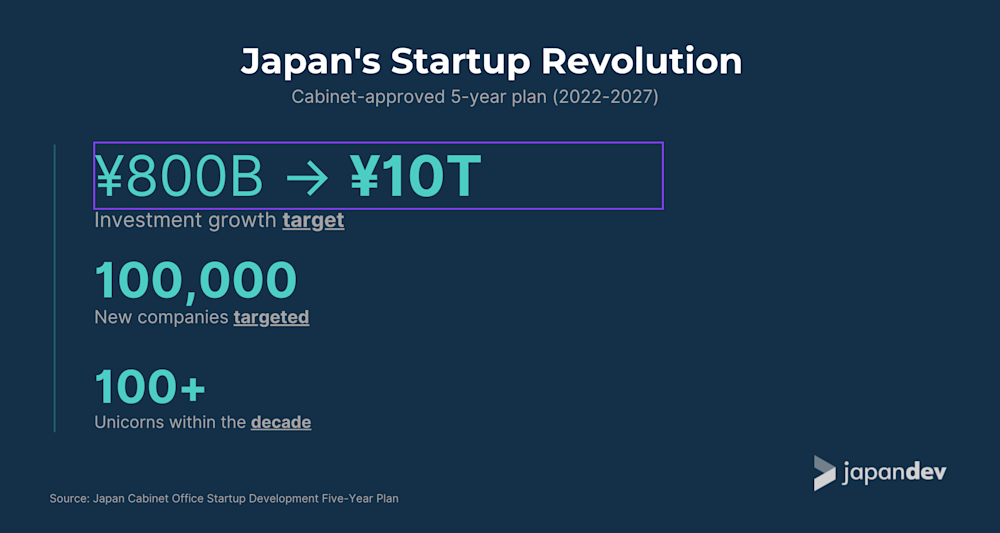
The government has an official five-year plan to grow startup investment from 800 billion yen to 10 trillion yen by 2027. That's not a rumor, a press release headline. It's a cabinet-approved policy with real money behind it. The plan targets 100,000 new companies and at least 100 unicorns within the decade.
This creates a good opening. Japan is trying to build an infrastructure to welcome global teams: visa programs, public funding pipelines, and physical hubs designed for international entrepreneurs.
But the ecosystem is layered. Should you join an incubator or an accelerator? Which programs accept foreign teams? What does a typical application look like?
This guide breaks it down. You'll find the top programs, eligibility criteria, a step-by-step application walkthrough, and practical advice on the common pitfalls as a foreign founder.
The Startup Landscape in Japan: Incubators vs. Accelerators
Before you take the first step anywhere, you need to understand which type of program fits your stage. Incubators and accelerators serve different founders at different points in their start-up's life. Picking the wrong one can waste months.
Defining Incubators in the Japanese Market
Incubators are for early-stage teams: founders with a strong idea or early research but no product yet.
In Japan, incubators focus a lot on deep tech. Think about biotech, robotics, advanced materials, quantum computing, and AI research. Most programs run for one to three years. Some extend further depending on technical milestones. The timeline is flexible by design.
Most Japanese incubators are non-dilutive. They don't take equity. Instead, they charge a program fee or subsidized rent. You get in exchange office or lab access, mentorship on intellectual property and regulatory compliance, and connections to research institutions and corporate partners.
What Makes a Japanese Accelerator Different?
Accelerators want teams with a working product to an extent. You need a minimum viable product (MVP) and early signs of traction before applying.
Programs run for three to six months in fixed cohort batches. At the end, you pitch at Demo Day. Investors and corporate partners attend. Most accelerators take a 5% to 7% equity stake in exchange for seed funding and structured mentorship.
What makes Japanese accelerators different from Western accelerators is the corporate matchmaking role. They serve as a bridge between foreign startups and large Japanese corporations. That means proof-of-concept (PoC) pilots, not just introductions. A successful PoC can turn into a commercial contract faster than you'd expect.
Here's a quick comparison of the two models:
Incubator |
Accelerator |
|
Stage |
Idea stage, pre-product |
MVP with early market traction |
Timeline |
1 to 3+ years, flexible |
3 to 6 months, fixed cohort |
Equity |
Non-dilutive (usually) |
5% to 7% equity stake |
Focus |
R&D, IP protection, lab access |
Sales, fundraising, Demo Day |
Typical Backer |
Universities, government bodies |
VC firms, corporate consortia |
Mentorship Style |
Academic translation, grant writing |
Go-to-market, investor prep |
Why Launch in Japan Right Now?
Japan's window is open. Foreign founders have more institutional support today than at any point in modern Japan's economic history.
The cabinet's "Startup Development Five-Year Plan," approved in 2022, is at the center of this change. The plan introduced three pillars: growing entrepreneurial talent globally, expanding public and private venture capital, and driving open innovation between corporations and startups. Execution is underway.
The Tokyo Metropolitan Government is running its own campaign alongside the national plan. The "Global Innovation with STARTUPS" sets a 10x10x10 goal over five years; ten times more unicorns, ten times more new startup registrations, and ten times more public-private partnerships. The Tokyo Innovation Base (TIB), a new physical hub in Yurakucho, opened in 2024 to anchor this effort.
As the Tokyo vs. Silicon Valley comparison on Japan Dev explains, Tokyo is no longer playing catch-up with global tech hubs. It's building a distinct identity and doing it with government money behind it.
The Startup Visa
The Startup Visa is the most important immigration reform for foreign founders in recent years. Under normal rules, a foreign national starting a company in Japan must qualify for a Business Manager Visa.
The Startup Visa delays the Business Manager Visa requirements for up to two years. You get a 24-month runway to do market research, register the company, line up an office, and secure initial funding, all while living legally in Japan.
To get it, you submit a Business Startup Preparation Activity Plan to a certified municipality or a recognized organization like JETRO. The plan outlines your value proposition, timeline, and financial projections. Once approved, the municipality issues a Certificate of Confirmation. You then apply to immigration for the actual visa.
Full details, including which cities are certified to process applications, are on the METI Startup Visa page. Capital requirements for transitioning to a standard Business Manager Visa are in the official METI PDF guideline.
Public Funding and Infrastructure
Beyond the visa, public funding is real and accessible. Japan Finance Corporation offers low-interest startup loans with minimal collateral requirements. The government's J-Startup program selects high-potential companies for priority access to over 500 corporate partners and fast-tracked regulatory approvals.
Physical spaces like the Tokyo Innovation Base, Shibuya Startup Support, and STATION Ai in Nagoya, Aichi, provide co-working, hardware prototyping labs, and legal guidance in one building.
Top Startup Incubators in Japan for Early-Stage Teams
These programs are for founders still deep in research and development. Seed-stage incubator programs in Japan offer long timelines, non-dilutive structures, and access to infrastructure hard to build on your own.
1. 1stRound (UTokyo IPC)
UTokyo IPC (University of Tokyo Edge Capital Partners) runs 1stRound alongside a coalition of 22 universities and five national research institutions, including JAXA, RIKEN, and the National Institute of Advanced Industrial Science and Technology (AIST).
Focus sectors: Deep tech, robotics, quantum computing, life sciences, AI, space tech, advanced materials
What you can get:
Up to 10 million yen in non-dilutive grant funding
Free co-working space and cloud computing credits
Hands-on mentorship in corporate governance, IP protection, and team building
Connections to 24 major corporate partners, including Ajinomoto and ENEOS, for commercial pilot trials
The program takes no equity. That makes it one of the most founder-friendly options in Japan for pre-seed deep tech teams.
Notable alumni: Quantum computing ventures from the University of Tokyo's Furusawa-Endo laboratory and Alumnote (a university-focused fundraising platform).
2. Beyond BioLAB TOKYO
Beyond Next Ventures, a VC firm focused on deep tech, operates this wet-lab incubator in Tokyo's Nihonbashi life sciences district.
Focus sectors: Biotechnology, molecular therapeutics, regenerative medicine, gene editing, synthetic biology
What you might get:
Shared P2 and BSL-2 certified wet lab space, with no security deposit
Analytical instruments on-site: CO2 incubators, autoclaves, PCR systems, ultra-low temperature freezers
On-site lab managers who handle safety protocols, waste disposal, and compliance
Business planning support and pathways to VC funding through Beyond Next Ventures
This incubator runs on a rental-bench model. There's no equity to join the lab, though Beyond Next Ventures can make a separate investment if they see potential.
Notable alumni: IDDK (microscopic imaging devices), STAND Therapeutics (intracellular therapeutics), Celusion (corneal regenerative medicine).
3. Keio Fujisawa Innovation Village (SFC-IV)
Keio University and SME Support Japan (SMRJ) run this incubator at Keio's Shonan Fujisawa Campus in Kanagawa Prefecture.
Focus sectors: Information technology, mobile, edtech, regional development, social entrepreneurship
What you get:
Subsidized private offices and co-working environments for early-stage software and hardware teams
Dedicated SMRJ managers for grant applications, compliance guidance, and commercial planning
Access to Keio's research faculty and corporate alumni network
Connections to regional manufacturing partners
Notable alumni: LoiLo, a developer of educational software now used in schools across Japan.
4. East Tokyo Kashiwa Venture Plaza
SMRJ and local authorities operate this incubator in Kashiwa, Chiba Prefecture.
Focus sectors: Advanced engineering, new materials, precision hardware manufacturing, smart city infrastructure
What you get:
Industrial space with 5-meter ceiling clearances for heavy machinery and pilot manufacturing equipment
Technical mentorship from engineering faculty and industrial advisors
Help securing public R&D subsidies and navigating manufacturing regulations
Connections to regional precision machining suppliers
This is the right choice if your startup involves hardware prototyping or manufacturing at scale. Software-only teams should probably look elsewhere.
Best Startup Accelerators in Japan for Rapid Growth
These programs want you to arrive with a product. Offers real funding, mentorship and corporate relationships that can very well take years to build on your own.
1. Techstars Tokyo
Techstars Tokyo launched in 2023. A partnership between pre-seed investor Techstars, real estate developer Mitsui Fudosan, and JETRO. The program runs at Innovation Field Yaesu inside Tokyo Midtown Yaesu.
What they are looking for:
Founders with deep, validated knowledge of their target users' problems
Japanese startups pursuing international expansion, or international teams entering Japan
Sector-agnostic, but prioritizes globally ambitious teams
Investment terms:
$120,000 total: $100,000 via an uncapped MFN SAFE (or J-KISS instrument), plus $20,000 via a post-money Convertible Equity Agreement
5% equity stake in common stock, plus future value from the converted SAFE
Full application details are at the Techstars Tokyo portal.
2. STATION Ai (Nagoya)
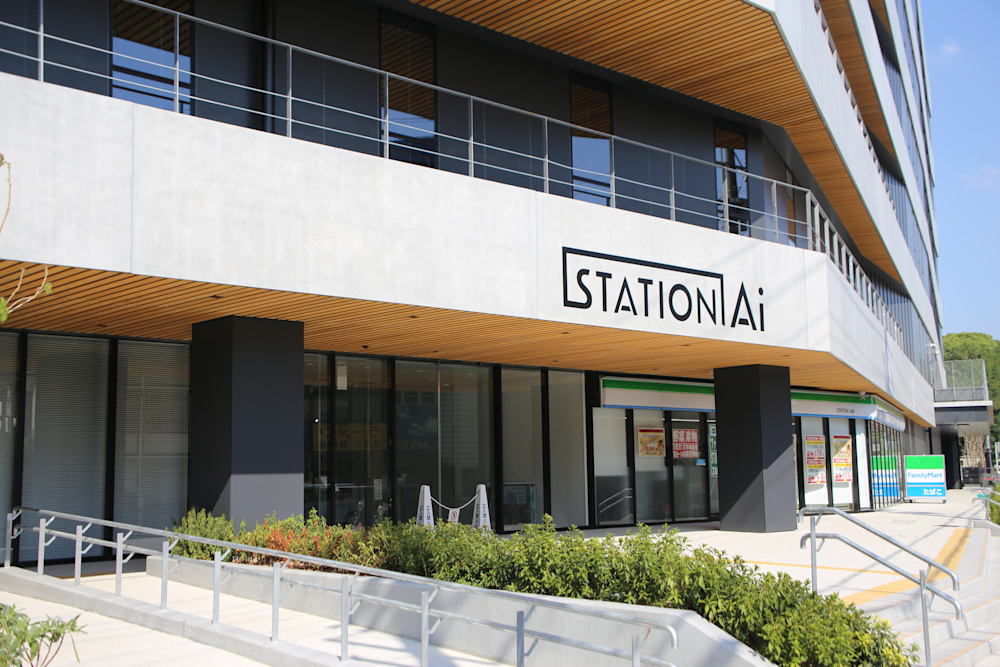
SoftBank's subsidiary STATION Ai, a 23,000-square-meter startup hub in Nagoya, Aichi Prefecture. It's one of the largest startup support facilities in Japan outside Tokyo.
They look for:
AI, hardware, mobility, and green transformation (GX) startups
Teams with strong GPU or computing resource requirements
Startups that can connect with Aichi's automotive and industrial base
Investment terms:
Basic co-working and programs participation is equity-free
A dedicated STATION Ai Fund makes separate Equity investments in high-potential startups
Programs include the "STATION Ai Catapult," the "AI Boost Program" (backed by SoftBank and NVIDIA), and student-led tracks.
3. Open Network Lab (Onlab)
Onlab has been running since 2010, making it Japan's oldest private seed accelerator. Digital Garage operates it in Shibuya, Tokyo.
What they look for:
Technical co-founding teams who commit full-time to the program
Founders who hold the majority of voting shares
A functional MVP and early market validation before applying
Investment terms:
Up to 5 million yen in seed capital
Minor equity stake under standardized seed-stage terms
Co-working space in Shibuya, plus hands-on product-market fit coaching and design support
Alumni: SmartHR (HR cloud platform, now a unicorn), Giftee (e-gifting platform), Fablic ( flea market app, acquired by Rakuten).
Check the Onlab program page for more details.
4. Plug and Play Japan
Plug and Play Japan runs from Shibuya. They focus on connecting startups with large corporate networks across many industries.
What they look for:
Early to growth-stage startups, generally under 10 years old
A working MVP or prototype ready for corporate pilot testing
Teams that can work bilingual (Japanese and English) business conversations
Investment :
Core vertical accelerator programs are equity-free
The program is funded by corporate partners, with a primary goal of facilitating proof-of-concept trials
Plug and Play's global venture arms can make separate equity investments in standout startups
Verticals covered: Insurtech, Mobility, Health, DeepTech, Energy, Food and Beverage
Quick Comparison
Program |
Equity |
Funding |
Duration |
Sector |
Techstars Tokyo |
5% + SAFE |
~$120,000 |
3 months |
Agnostic |
STATION Ai |
Equity-free (fund separate) |
Varies |
Varies |
AI, Mobility, GX |
Open Network Lab |
Minor stake |
Up to 5M yen |
3 months |
Software, internet |
Plug and Play Japan |
Equity-free |
None (PoC focus) |
Varies |
Multi-sector |
How to Apply to Japanese Accelerators and Incubators:
This will need more than a good idea. The timeline followed by Japanese accelerators is what you need to understand before you start.
Here's the full process from research to acceptance:
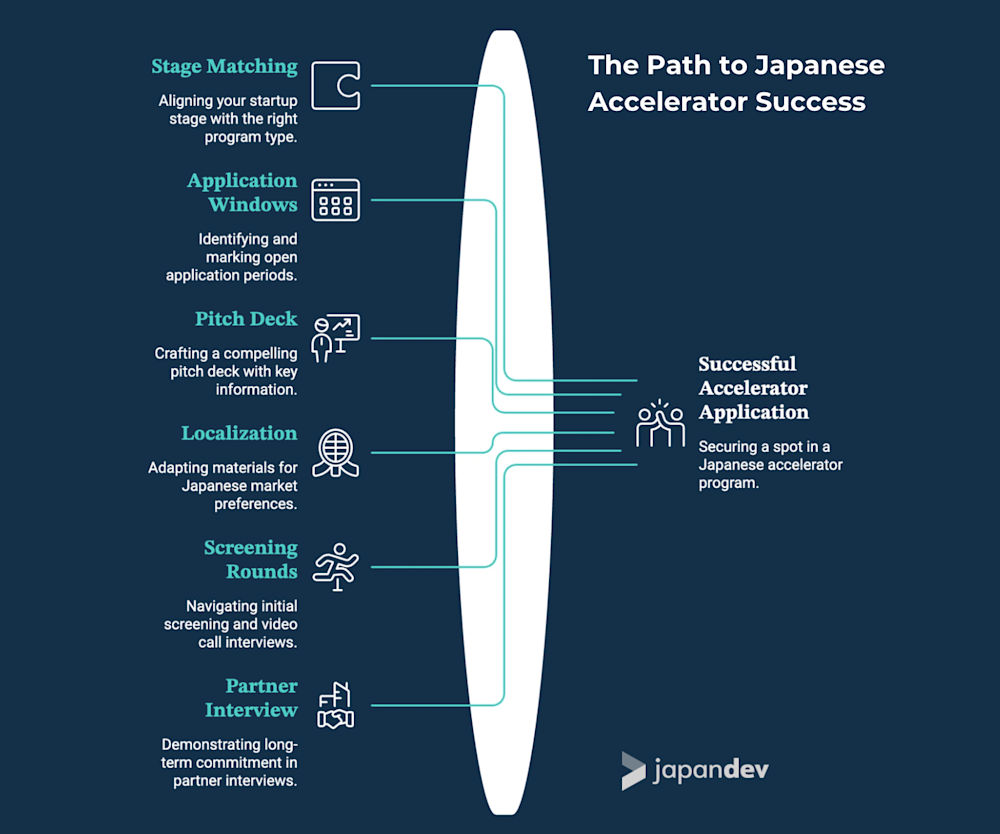
Step 1: Match your stage to the right program type
Go back to the comparison table at the top of this article. If you're pre-product, look at incubators. If you have an MVP and traction, look at accelerators. Just to avoid applying to the wrong type and wasting time.
Step 2: Research open application windows
Onlab runs two cohorts per year: summer and winter. Techstars Tokyo runs one annual cohort. Plug and Play and STATION Ai run rolling or vertical-specific cohorts. Mark your calendar at least six to eight weeks before you plan to apply. Rushed applications not recommended.
Step 3: Build your pitch deck
Most Japanese selection committees want a deck of 10 to 15 slides. Make sure to cover these points:
The specific problem you're solving
Your target market, sized with real data
Your solution and an MVP demo or prototype walkthrough
Early traction: users, revenue, pilots, letters of intent
Your team and why you're the right people to win
If you're applying to Techstars Tokyo or Plug and Play, your deck must answer a Japan-specific question: Why Japan? What's your path to a Japanese customer or enterprise partner?
Step 4: Localize your materials
Many programs accept English applications. But some municipal or SMRJ-linked incubators want a Japanese version of your business plan. At least, prepare a one-page Japanese executive summary.
Step 5: Clear the screening rounds
Most programs run two to three screening rounds. The first is a paper review. If your application clears that, you'll get a video call with an associate or program manager.
Come ready to explain your business in three minutes or less. Know your key metrics cold. Don't use big technical words. Try to speak plainly and confidently.
Step 6: Partner interview
The final round usually involves two or three partners or senior mentors. They'll challenge your assumptions. Expect questions about:
Who else is solving this problem, and why will you win
Your unit economics: customer acquisition cost, lifetime value, margin
Your Japan market entry plan and timeline
One thing matters more than anything else at this stage: long-term commitment. Selection committees are not interested in founders testing Japan as a side market. They want teams who have decided Japan is the priority.
Step 7: Terms and acceptance
Once accepted, read the term sheet. For equity programs, confirm the SAFE or J-KISS terms and the total dilution. For equity-free programs, check space requirements, minimum time commitments, and any monthly fees.
The Legal Pipeline: Visas, Incorporation, and Support
Getting your legal and operational foundation right is a separate challenge that also runs in parallel.
Once you're in Japan on a Startup Visa, you'll need to register your company. The standard structure for foreign-founded startups is usually the Kabushiki Kaisha (KK), or joint-stock company. A simpler, cheaper option is the Godo Kaisha (GK), or limited liability company. Most VC firms, however, prefer the KK structure because it's more compatible with standard equity investment instruments.
The starting a business in Japan guide covers the full registration process, including required documents and typical costs.
Regional Hubs and Soft Landing Pads
Tokyo is the obvious choice. But it's not your only one.
Tokyo (Shibuya ward): The Shibuya ward runs a dedicated startup support program with English-friendly admin help and Startup Visa processing. The Shibuya Startup Support program acts as a certified Foreign Entrepreneurship Support Organization. That means it can process your visa application directly and walk you through administrative registration. If you're based in or around Shibuya, start here.
Nagoya: STATION Ai's presence makes Nagoya a serious option for hardware, automotive, and AI-adjacent startups. The city actively recruits global teams, and costs are lower than Tokyo.
Fukuoka: Fukuoka has a special startup economic zone, a city government that courts international founders, and a cost of living that makes an extended runway possible. The living in Fukuoka guide gives a full picture of life and work in the city. For startups outside deep tech or automotive, Fukuoka's supportive community and lower burn rate make it worth a serious look.
If you're accepted to an accelerator based in one of these cities, ask them directly about Startup Visa support. Many programs, particularly those backed by certified municipalities, can help streamline your application.
Common Pitfalls for Foreign Founders
Japan's startup ecosystem is more international than it was five years ago. That said, some obstacles catch foreign founders off guard every cohort. Being ahead before you apply will save real time and money.
Language Barriers and Localizing Your Product
Not every program requires Japanese, and English-friendly startup programs in Japan are growing every year. But corporate pilots are a different story.
When an enterprise partner wants to run a proof-of-concept with your product, expect at least some communication in Japanese. Contracts, compliance documents, and stakeholder presentations usually stay in Japanese regardless of how international the company is.
Having a Japanese co-founder, a bilingual advisor, or a good local hire on your team changes a lot how programs perceive your application. It's a commitment, and it will be of a great benefit for your growth.
On the product side, localization goes beyond translation. Japanese UX conventions actually differ from other ones. Information density is higher. Menu structures are different. Test your product with real Japanese users before pitching it to a corporate partner. A pilot that breaks down at the product demo is worse than no pilot at all.
Corporate Cultural Expectations and Nemawashi (Consensus Building)
Nemawashi (根回し) is a Japanese concept that describes how teams build consensus before making a formal decision. In practice, it means that important decisions rarely happen in a single meeting.
If a corporate partner shows interest in your startup after Demo Day, don't expect a signed contract the following week. There might be five internal meetings you never see, with many stakeholders reviewing the proposal before anyone says yes. That's normal in Japan.
Mistakes foreign founders make is pushing for speed. In Japan, pushing too hard signals impatience and can be read as disrespect for the other party's process. Instead, be in regular contact. Send brief updates. Ask thoughtful questions about where things stand internally.
A few other cultural notes that matter in formal settings:
Business cards (meishi, 名刺) still carry weight at first meetings. Receive them with both hands. Read the card before setting it down. Do not write on it.
Punctuality is Important so being five minutes early is on time.
Japan has unique business etiquette that many foreigners might not be familiar with. While you might not be expected to adhere to every rule, small details help stick in the memory of the people deciding whether to partner with you.
Is a Japanese Program Right for Your Startup?
Japan isn't the right move for every founder. But for the right team, it offers something few other markets can: a path into one of the world's largest economies, backed by government-level investment in your success.
You should pursue a Japanese program if:
Your product has a clear, specific use case in the Japanese consumer or enterprise market
You're willing to commit at least one to two years to the country
You have, or can hire, some Japanese language capability on your team
You're working in deep tech, AI, mobility, green tech, or another sector Japan is actively funding
You want access to corporate enterprise partnerships that are hard to build from abroad
You might want to wait if:
You haven't validated your product in any market yet
Your team has no connection to Japan and no concrete plan to build one
Your current runway won't cover the timeline these programs need
You're looking for a quick test rather than a serious commitment
The programs listed in this guide are real resources with real outcomes, funding, mentorship, co-working space, corporate introductions, and visa pathways. But none of them replaces the work of understanding your Japanese user.
Japan rewards founders who show up prepared. The government is investing trillions of yen to build something new here. The programs above are the best front doors into that system.
If you're ready, start by identifying one or two programs that match your stage and sector. Mark the next application window. Start building your deck. And if you're thinking about what life on the ground actually looks like while you build your company here, the Japan Dev startups in Japan resource is a good next read.
The window is open. Step through it.


Hasan Ali
Born and raised in Libya, Hasan spent the last 6 years exploring Japanese culture while living in Nagano and Aichi. His journey began at a high school in the town of Karuizawa, followed by a Bachelor of Business in Nagoya. Professionally, He is an SEO and content specialist with over 3 years of experience crafting digital strategies. When not working, He is trying to catch up on his goal of visiting every single prefecture in Japan.
- Delivery Manager, LINK Ecosystem
- Moneytree
- Remote
- ¥8M ~ ¥10M
- Software Engineer – Open Position (Robotics / Backend, C++)
- Mujin
- Tokyo
- ¥8M ~ ¥15M
- Senior Software Engineer, Satellite Operations System Development...
- Axelspace
- Tokyo
- ¥6M ~ ¥9M
- Senior DevOps Engineer - Build Systems & CI
- Mujin
- Tokyo
- ¥10M ~ ¥13M



Latest Tech Jobs 🇯🇵
Explore the top developer jobs in Japan for foreigners
- Delivery Manager, LINK Ecosystem
- Moneytree
- Remote
- ¥8M ~ ¥10M
- Software Engineer – Open Position (Robotics / Backend, C++)
- Mujin
- Tokyo
- ¥8M ~ ¥15M
- Senior Software Engineer, Satellite Operations System Development...
- Axelspace
- Tokyo
- ¥6M ~ ¥9M
- Senior DevOps Engineer - Build Systems & CI
- Mujin
- Tokyo
- ¥10M ~ ¥13M
- Senior Product Engineer (Partner Product Development Department)
- Money Forward
- Tokyo
- ¥6.9M ~ ¥10M
- Senior Software Engineer
- MeetsMore
- Tokyo
- ¥7.5M ~ ¥10M
- Senior Backend Engineer
- Tokenz
- Tokyo
- Senior Accounting Engineer / 財務データ基盤エンジニア
- KOMODO
- Tokyo
- Tech Lead Engineer (Voice/Speech)
- Geniee
- Tokyo
- ¥7M ~ ¥16M





Get Job Alerts
Sign up for our newsletter to get hand-picked tech jobs in Japan – straight to your inbox.

© 2026 Japan Dev. All rights reserved.
Proudly built in Tokyo.


Curated with 💙 in Tokyo
All our data is gathered from publicly available sources or contributed by users