


Japan’s Child Vaccination Schedule: A Complete Guide for Expat Families
In this article: 📝
If you’re moving to Japan with a baby or young child, the Japan child vaccination schedule is one of the first things to get your head around.
The basics will feel familiar, but a few details catch parents off guard. Some shots are free, and some aren’t. The forms usually arrive in Japanese, and doses from back home don’t always line up with Japan’s timing.
Once you know how the system works, though, it’s mostly paperwork and booking appointments. It’s one of the smaller jobs that come with raising an international family in Japan.
Below you’ll find the full breakdown of Japan’s childhood vaccines for expats, what’s free, what vaccine costs look like for foreigners, how Japan compares with the US, UK, and Australia, and how to book your kid’s first shots.

How Vaccination Works In Japan: Routine Vs. Voluntary
Japan divides childhood vaccines (immunizations) into two main categories: teiki sesshu (定期接種), or routine vaccinations, and nini sesshu (任意接種), or voluntary vaccinations. Which group a vaccine falls into decides whether you pay and who keeps track of timing:
Routine vaccinations, teiki sesshu (定期接種). The government recommends these by law, and they’re part of Japan's public vaccination program. Your local municipal office pays for them if your child gets each dose within its age window.
Routine vaccinations include hepatitis B, rotavirus, the 5-in-1 shot, pneumococcal, BCG (tuberculosis), measles and rubella, chickenpox, Japanese encephalitis, and HPV for girls from 6th grade (~older than 12).
2. Voluntary vaccinations, nini sesshu (任意接種). These vaccines are recommended by doctors. Parents usually pay for them out of pocket, although some cities cover part of the cost. Costs vary by clinic, vaccine, and local subsidy rules.
These vaccines protect against common childhood illnesses in Japan, like mumps and flu. Others, like hand, foot, and mouth disease (a common seasonal daycare illness in Japan), have no vaccine at all.
Keep a close eye on the age window for routine vaccines. If your child misses the age range where the vaccine is free, it’s treated as a voluntary one, and you’ll have to pay full price.
And here’s the thing: routine doesn’t mean mandatory, though. Parents have a “duty to try,” not a legal requirement, so the choice is entirely yours.
Voluntary vaccines work differently. Your local municipal office won’t tell you when these vaccines are due or prompt you to get them, but you can ask a Japanese pediatrician which ones your child needs.
How the Voucher System Works
Japan pays for routine vaccines through a voucher system. Your local government office gives you a voucher for each routine shot, and you hand it over at the clinic instead of paying.
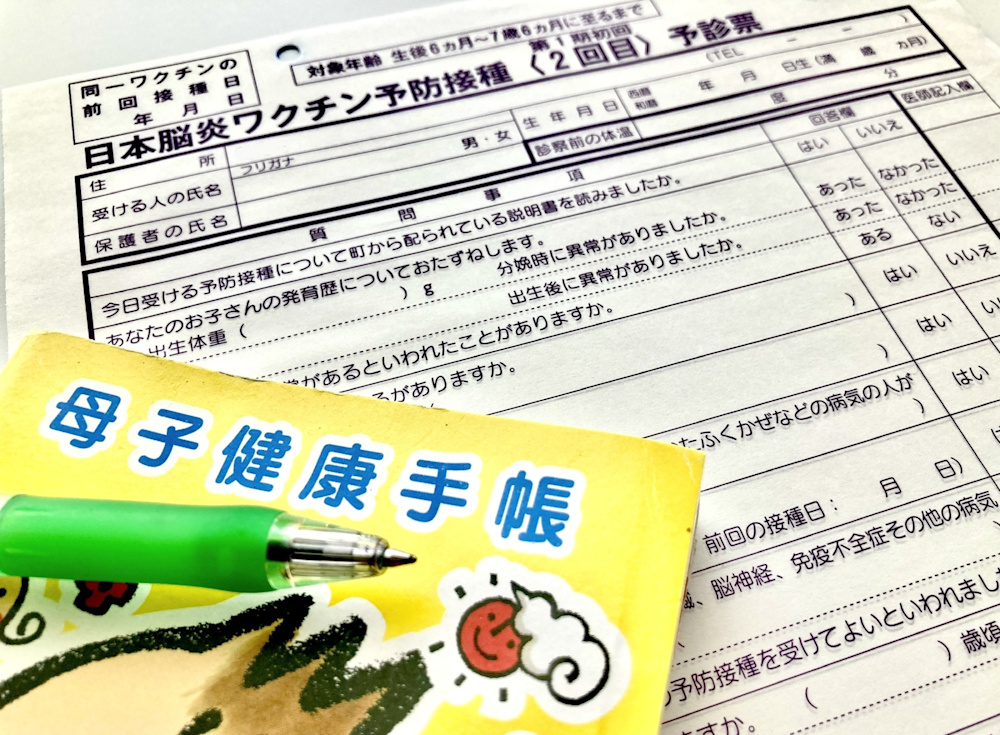
These voucher forms are called 予診票 (yoshinhyō), or pre-vaccination questionnaires. You don’t need to sign up for them. Your city office mails them to you before each shot is due.
In Setagaya City, for example, the first batch arrives by the end of the month when your baby turns one month old. Here’s how you use them:
Fill out the form at home.
Take it to a contracted clinic, along with your boshi kenkō techō (or boshi techō for short).
The clinic gives the shot and bills your city, so you pay nothing.
What is a Boshi Kenkō Techō?
The 母子健康手帳 (boshi kenkō techō) is Japan's maternal and child health handbook, similar to the UK’s physical Red Book (the Personal Child Health Record). If you’re giving birth in Japan, your local municipal office gives you one when the pregnancy is registered.
If you're moving to Japan after your child is born, ask your local government office how to get a handbook for your child.
In Japan, this handbook tracks your child’s vaccinations, health checks, and growth up to elementary school. Clinics use it to record every shot, so bring it along to every vaccination appointment.
If your child received vaccines abroad, bring their vaccine records to your first pediatrician visit, with the vaccine names and dates. Doctors can add those doses to your child’s boshi techō and work out which ones your child still needs.
The Full Japan Child Vaccination Schedule
Japan's childhood vaccination schedule starts when your baby is around 2 months old and continues into the school years. The table below covers the routine vs. voluntary vaccines in Japan that your child can get from birth to age 6, plus HPV for older girls.
For each vaccine, you’ll see its free age window, when doctors usually give it, and how many doses your child needs. The free age window is when your city pays for the shot.
If your child starts late or already had some shots from back home, the timing and number of doses can change, and your pediatrician in Japan will adjust the plan.
Vaccine |
Type |
Free age window |
Standard timing |
Doses |
Hepatitis B - B型肝炎 / B gata kanen |
Routine |
Under 1 year |
2, 3, and 7-8 months |
3 |
Rotavirus (Rotarix) - ロタウイルス(ロタリックス) / Rotauirusu (Rotarikkusu) |
Routine |
6-24 weeks |
1st dose before 15 weeks |
2 |
Rotavirus (RotaTeq) - ロタウイルス(ロタテック) / Rotauirusu (Rotatekku) |
Routine |
6-32 weeks |
1st dose before 15 weeks |
3 |
5-in-1 (DPT-IPV-Hib) - 五種混合 / Goshu kongō |
Routine |
2 months to 7.5 years |
3 doses from 2 months, booster 6-18 months later |
4 |
Pneumococcal (PCV20 or PCV15) - 小児肺炎球菌 / Shōni haienkyūkin |
Routine |
2 months to under 5 years |
3 doses from 2 months, booster at 12-15 months |
4 |
BCG (tuberculosis) |
Routine |
Under 1 year |
5-8 months |
1 |
MR (measles and rubella) - 麻しん風しん混合 / Mashin Fūshin kongō |
Routine |
1 to under 2 years, then the year before elementary school |
Soon after 1st birthday, then age 5-6 |
2 |
Chickenpox - 水痘 / Suitō |
Routine |
1 to under 3 years |
12-15 months, then 6-12 months later |
2 |
Japanese encephalitis - 日本脳炎 / Nihon nōen |
Routine |
6 months to 7.5 years, or from age 9 to under 13 (through the day before the 13th birthday) |
2 doses at age 3 (6-28 days apart), booster around a year later, and 1 dose between the ages of 9 and 10. |
4 |
Mumps - おたふくかぜ / Otafukukaze |
Voluntary |
None |
Soon after 1st birthday, then the year before elementary school |
2 |
Flu - 小児インフルエンザ / Shōni infuruenza |
Voluntary |
None |
Every fall from 6 months |
2 per season under 13 |
HPV |
Routine |
6th grade to 1st year of high school |
1st year of junior high |
2-3 |
A few things to know about this table:
Pneumococcal shots switched to PCV20 in October 2024, though some clinics still use PCV15. Both are free, and your child should usually finish the series with the same type they started on.
Rotavirus is the one to watch if you’re arriving with a young baby. It’s given as drops by mouth, and the 1st dose should happen before 15 weeks, so book it as soon as you can. The 2 rows in the table are 2 brands, and your clinic decides which one to use.
The 5-in-1 shot is fairly new. Japan added it to the routine schedule in 2024, replacing the separate 4-in-1 and Hib shots, so older siblings’ records may look a little different.
Vaccine schedules in Japan change often, so check the Japan Pediatric Society’s latest schedule or ask your pediatrician before you book. If you don’t read Japanese, its English version is a helpful guide, though JPS updates it less often.
Later Doses for Older Kids
After age 6, three routine vaccines come up, and your local municipal office will mail you the forms when they’re due. Your child gets a Japanese encephalitis booster at age 9 and a diphtheria-tetanus (DT) booster at age 11, and both are free until they turn 13.
Girls can also get the HPV vaccine for free from ages 12 to 16 (6th grade to the first year of high school in Japan), spread across 2 to 3 doses.
Japan vs. the US, UK, and Australia: How Vaccine Schedules Compare
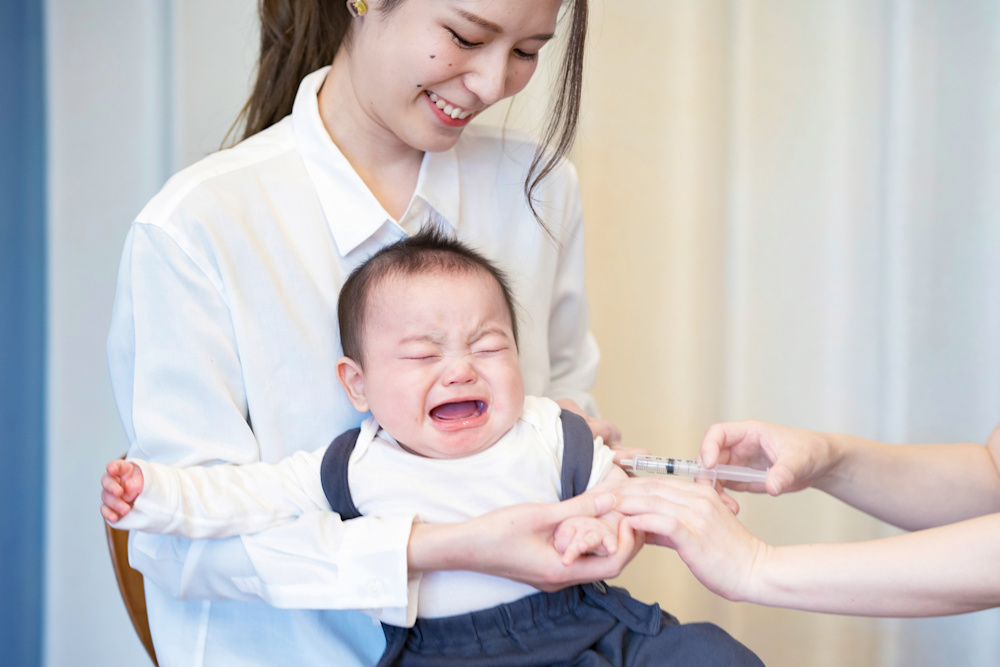
Many of Japan’s childhood vaccine schedules will look familiar if you’re coming from the US, UK, or Australia. The main differences are when each immunization is given, which vaccines are combined into one shot, and a couple of vaccines you may not have seen before coming to Japan.
If your child already started their vaccines at home, don’t expect every dose to line up with Japan’s dates. Here’s how the schedules compare for babies and young children:
Japan |
US |
UK (England) |
Australia |
|
First routine shots |
2 months |
Birth (hepatitis B), then 2 months |
8 weeks |
Birth (hepatitis B) |
Combination vaccines |
5-in-1 (DPT-IPV-Hib) at 2, 3, and 4 months, plus a booster after age 1 |
Listed as separate vaccines, mostly at 2, 4, and 6 months |
DTaP/IPV/Hib/HepB (6-in-1) at 8, 12, and 16 weeks, plus 18 months |
6-in-1, including hepatitis B, at 2, 4, and 6 months |
BCG (tuberculosis) |
Every baby, at 5-8 months |
Not used routinely |
Only some higher-risk babies, within 28 days of birth |
Only some higher-risk babies |
Measles |
MR at 12-23 months, then at 5-6 years (mumps is a separate shot at 12-15 months) |
MMR at 12-15 months, then at 4-6 years |
MMRV at 12 and 18 months |
MMR at 12 months; MMRV at 18 months |
Chickenpox |
Own shot, 2 doses from 1 year |
Own shot at 12-15 months, then at 4-6 years |
Part of MMRV, at 12 and 18 months |
Part of MMRV at 18 months |
Japanese encephalitis |
Routine from age 3 |
Not on the routine schedule |
Not on the routine schedule |
Not on the routine schedule |
The differences that matter most:
Japan’s MR vaccine covers measles and rubella, but not mumps. Mumps is a separate voluntary shot in Japan, so you may need to book and pay for it yourself.
Japan gives the 2nd measles dose at age 5-6, close to the US at 4-6. The UK and Australia give it much earlier, at 18 months.
Japanese encephalitis will probably be new to you. It’s a brain infection spread by mosquitoes in parts of Asia, and Japan routinely vaccinates every child against it from age 3.
Note: Schedules change often in every country, so always check the official sources.
Why Japan Gives Every Baby the BCG Vaccine
Bacille Calmette-Guérin (BCG) is the tuberculosis (TB) vaccine Japan gives every baby, as one dose between 5 and 8 months. The US doesn’t use it routinely, and the UK and Australia only give it to some higher-risk babies.
Japan’s TB rate was 8.0 per 100,000 people in 2025. It only fell below 10, the line for a “low-incidence” country, in 2021, and it’s still higher than most other wealthy countries.
Babies aren’t born with any immunity to TB from their mothers. In babies and young children, TB is harder to spot and more likely to turn serious, spreading through the body or causing meningitis, so Japan vaccinates early.
BCG isn’t a regular needle shot. The doctor drips the vaccine onto your baby’s upper arm, then presses a small stamp with 9 tiny needles into two spots. You let it air-dry for about 10 minutes.
What If Your Child Started Vaccinations Abroad?
You don't need to restart every vaccine series simply because you moved to Japan. A pediatrician here can review your child's existing doses and work out which ones are still needed on the Japanese schedule.
Bring your child’s record from home with the vaccine names and dates, plus a translation or clear explanation if it’s in another language.
Where to Get Your Child Vaccinated in Japan and What It Costs
In Japan, most routine vaccines happen at local clinics called 委託医療機関 (itaku iryo kikan). These clinics have a contract with your local municipal office to provide publicly funded vaccinations. Your free forms (vaccine vouchers, 予診票 yoshinhyō) only work at these clinics, and your local government office’s website lists them.
Hospitals can be on the list too, but many only vaccinate patients they already see. A neighborhood pediatric clinic is often the simplest place to start if you’ve just moved here.
How To Register And Book An Appointment
Here’s the order to do it in:
Register your address at your local municipal office. Free vaccines depend on resident registration, so do this soon after you move.
Get your vouchers. If your child was born in Japan, the vouchers arrive by mail. If you moved with an older child, ask your local municipal office for them (Setagaya, for example, takes requests online or by phone), and for a boshi techō if you don’t have one.
Pick a contracted clinic from your local municipal office’s list. Some English-speaking hospitals in Tokyo also give routine shots, so ask whether they take your local municipal office’s forms.
Book an appointment. Many clinics require advance bookings, which you can usually make by phone or through the clinic’s online booking page. Ask whether they have the vaccine your child needs and if they can give several vaccines in the same visit. This is common at 2 months and around the 1st birthday, when several vaccines are due at once.
Bring your documents. Take your vouchers, the boshi techō, your child’s health insurance card or another ID, and any vaccine records from abroad.
It's worth booking early, especially at popular clinics or when several doses are due close together. Some vaccines have strict age limits, so tell the clinic your child's date of birth and the dates of any previous vaccinations when making the appointment.
If you’re also planning childcare in Japan, try to finish the routine shots before daycare starts. Kids pick up a lot of seasonal illnesses at daycare in Japan, so it helps to have the shots you can get out of the way first. For everything else (the coughs, fevers, and runny noses that no vaccine covers), our guide to children’s medicine in Japan covers what to expect from Japanese pharmacies and clinics.
How to Get a Flu Shot for Your Child
Flu shots are voluntary in Japan, so you book and pay for them yourself. Here’s how it usually works:
Book early. Many clinics open bookings in late September or early October and start giving shots in October.
Plan for two doses if your child is under 13. They’re normally spaced 2-4 weeks apart, and some clinics make you book both at once.
Expect to pay about ¥3,500-¥5,000 per dose. The 2nd dose is often cheaper, and some cities help with the cost. In Nagasaki, for example, kids pay ¥1,750 per shot.
Bring your kid’s boshi techō, as some clinics won’t give the shot without it.
How Much Do Childhood Vaccines Cost In Japan?
Routine vaccines are free within the eligible age window, and vaccine costs are the same for foreigners as for Japanese families once you’re registered as a resident. You’ll have to pay if you miss the window, forget your form, or go to a clinic that isn't on your city’s list.
Voluntary vaccines aren’t free, and they cost roughly ¥3,000-¥22,000 per dose. Flu shots usually cost about ¥3,500-¥5,000, and mumps shots about ¥4,000-¥9,000, while less common vaccines like the meningococcal shot can be over ¥20,000.
Each clinic sets its own price, though, so the same vaccine can cost more at one clinic than another. Many cities help with some of them. Mumps subsidies, for example, cost about ¥2,000 (Izumo City) to ¥5,000 (Ishioka City) per dose, depending on where you live.
Check your city office’s website for its current subsidies before you book. Japan’s monthly child allowance isn’t tied to vaccines, but it can help cover costs like these.
Frequently Asked Questions
Is Child Vaccination Free in Japan?
Routine vaccinations (定期接種 teiki sesshu) are free in Japan as long as your child gets each dose within its age window. Your local government office pays through a voucher system, and foreign residents qualify the same way as Japanese families once they’re registered as residents. If your child misses the window, you’ll pay full price for that dose.
Voluntary vaccines (任意接種 nini sesshu) aren’t free and can cost up to ¥22,000. Prices vary by vaccine and clinic.
Is the BCG Vaccine Mandatory in Japan?
No. BCG is a routine vaccine in Japan, so it’s free and strongly recommended, but parents have a “duty to try” rather than a legal requirement. Babies usually get 1 dose at 5-8 months, and it’s free only before their 1st birthday. The US doesn’t use BCG routinely because TB risk there is low, which makes it one of the biggest differences expat parents notice.
Can I Continue My Child's Vaccinations from Another Country in Japan?
Yes. A Japanese pediatrician can review your child's vaccine records and match previous doses to Japan's schedule. Bring records showing the vaccine names and dates to your first appointment, with an English translation if they’re in another language. The doctor will note completed doses in the boshi techō and, if your child is behind, plan catch-up shots using the Japan Pediatric Society’s catch-up schedule.
What is Boshi Techō, and Do I Need One for Japanese Vaccinations?
The boshi kenkō techō (母子健康手帳), or boshi techō for short, is Japan's maternal and child health handbook. Your local government office gives you one when you register a pregnancy, and families who move to Japan with a child already born can ask their local municipal office how to get one.
Clinics record every vaccine, health check, and growth milestone in it, so it works as your child’s official vaccine record. You’ll need to bring it to every vaccination visit, along with any vaccination records from abroad.
Is the Hepatitis B Vaccine Routine in Japan?
Yes, the hepatitis B vaccine is a free routine vaccine in Japan for babies under one. Most babies get 3 doses, at around 2, 3, and 7-8 months. Unlike in the US and Australia, Japan doesn’t usually give the first dose at birth.
Do Daycare and Schools in Japan Require Proof of Vaccination?
No. Japan doesn’t make vaccination a condition for entering daycare or school, and the government has said licensed daycares can’t turn away a child for being unvaccinated.
Daycares may still ask to see your child’s vaccine history in the boshi techō during enrollment. The Japan Pediatric Association recommends finishing routine shots before group care starts, to protect your child and the other kids.
Final Words on Childhood Vaccination Schedules in Japan
For expat families, Japan's childhood vaccines can look unfamiliar at first, but the system is manageable. Once you understand the difference between routine and voluntary vaccines and know how to book with a local clinic, the rest comes down to bringing the boshi techō to every appointment.
Disclaimer: This article is for informational purposes only and is not a substitute for medical advice. Vaccination schedules and eligibility rules can change. Consult your child's pediatrician and check official Japanese guidance before making vaccination decisions.


日本在住の編集チームが、日本のテック業界と暮らしに関するガイドや記事をお届けします。記事は日本の政府機関の情報をもとに調査し、編集基準はJapan Dev共同創業者のManami Turnerが監修しています。
- Senior Backend Engineer
- Tokenz
- 東京
- Product Manager - ASRS (Automated Storage & Retrieval System)
- Rapyuta Robotics
- 東京
- Mobile Engineer (Sales AI Agent)
- ExaWizards
- 東京
- 648万〜1,008万円
- DevOps Engineer
- ExaWizards
- 東京
- 700万〜1,000万円
- Senior DataOps Engineer, Data Platform Section - DPD
- Rakuten Group
- 東京
- 1,000万〜1,400万円




新着エンジニア求人
多国籍チームで活躍できる、新しい求人をチェック
- Senior Backend Engineer
- Tokenz
- 東京
- Product Manager - ASRS (Automated Storage & Retrieval System)
- Rapyuta Robotics
- 東京
- Mobile Engineer (Sales AI Agent)
- ExaWizards
- 東京
- 648万〜1,008万円
- DevOps Engineer
- ExaWizards
- 東京
- 700万〜1,000万円
- Senior DataOps Engineer, Data Platform Section - DPD
- Rakuten Group
- 東京
- 1,000万〜1,400万円
- DevOps Engineer- Data Platform Department (DPD)
- Rakuten Group
- 東京
- 560万〜750万円
- QA Automation Engineer
- Rakuten Group
- 東京
- 700万〜1,300万円
- Frontend Engineer (React Native)
- Mujin
- 東京
- 800万〜1,200万円
- Junior Product Manager
- Owndays
- 東京
- 400万〜650万円
- Robotics Perception Engineer – Logistics Division
- Telexistence
- 東京



求人アラートを受け取る
ニュースレターに登録して、厳選した日本のIT求人をメールで受け取りましょう。

© 2026 Japan Dev. All rights reserved.
東京から開発・運営しています。


Curated with 💙 in Tokyo by Eric Turner
掲載情報は、公開されている情報とユーザーからの提供をもとにしています